
LOADING...
Ramesh wanted to sell an old smartphone through an online marketplace. Within a few hours of posting the advertisement, he received a call from a person claiming to be a buyer.
Ramesh wanted to sell an old smartphone through an online marketplace. Within a few hours of posting the advertisement, he received a call from a person claiming to be a buyer.
The caller sounded genuine and agreed to purchase the phone without negotiating the price.
To build trust, the buyer said:
“Sir, I will send ₹1 first to verify your UPI ID. After that, I will transfer the full amount.”
A few seconds later, Ramesh received a payment request on his UPI app.
The message looked authentic.
Without paying much attention, he entered his UPI PIN.
Within minutes, multiple transactions were processed from his bank account.
By the time Ramesh realized something was wrong, ₹98,000 had been debited.
The “buyer” switched off his phone and disappeared.
Many consumers believe that entering a UPI PIN is required to receive money.
This is false.
To receive money, you generally do not need to enter your UPI PIN.
Entering a UPI PIN usually authorizes a payment from your account.
Fraudsters exploit this misunderstanding to steal money.
Their goal is usually the same: trick the consumer into authorizing a transaction.
Instead of waiting until the next day, Ramesh acted within minutes.
He:
Called his bank’s customer care.
Requested immediate blocking of digital transactions.
Reported the fraud on the national cybercrime helpline 1930.
Filed an online complaint on the cybercrime reporting portal.
Preserved screenshots of the transactions and call logs.
In digital fraud cases, time is critical.
The higher the chance of freezing the funds.
The greater the possibility of tracing the beneficiary account.
The stronger the investigation trail.
Delays can significantly reduce recovery prospects.
Because Ramesh reported the fraud quickly, authorities initiated the financial fraud response process.
A portion of the transferred amount was traced before it could be fully withdrawn.
Although not every case results in complete recovery, prompt reporting substantially improved his chances.
Someone asks you to enter your UPI PIN to receive money.
A stranger sends a QR code and asks you to scan it for payment.
A caller claims to be from a bank and requests OTPs.
You are asked to install a screen-sharing application.
A “customer care” number is found through an online search rather than an official source.
(Very Important)
Call 1930 immediately.
Inform your bank without delay.
Block compromised payment channels.
Take screenshots of all transactions.
File a cybercrime complaint online.
Keep the complaint reference number safely.
Many victims feel embarrassed and delay reporting the incident.
Cyber experts repeatedly emphasize that immediate reporting is far more important than trying to investigate the fraudster yourself.
Every minute can matter.
“Digital payments have made transactions easier, but consumers must understand a basic rule: never share OTPs, never disclose banking credentials, and never enter a UPI PIN merely to receive money. Awareness remains the strongest defense against payment fraud.”
(Remember)
“Enter your UPI PIN to receive money.”
Treat it as a warning sign.
Receiving money does not usually require your UPI PIN.
Report fraud immediately through 1930 and your bank.
Preserve every piece of evidence.
In cyber fraud cases, acting within minutes can make the difference between recovering your money and losing it permanently.
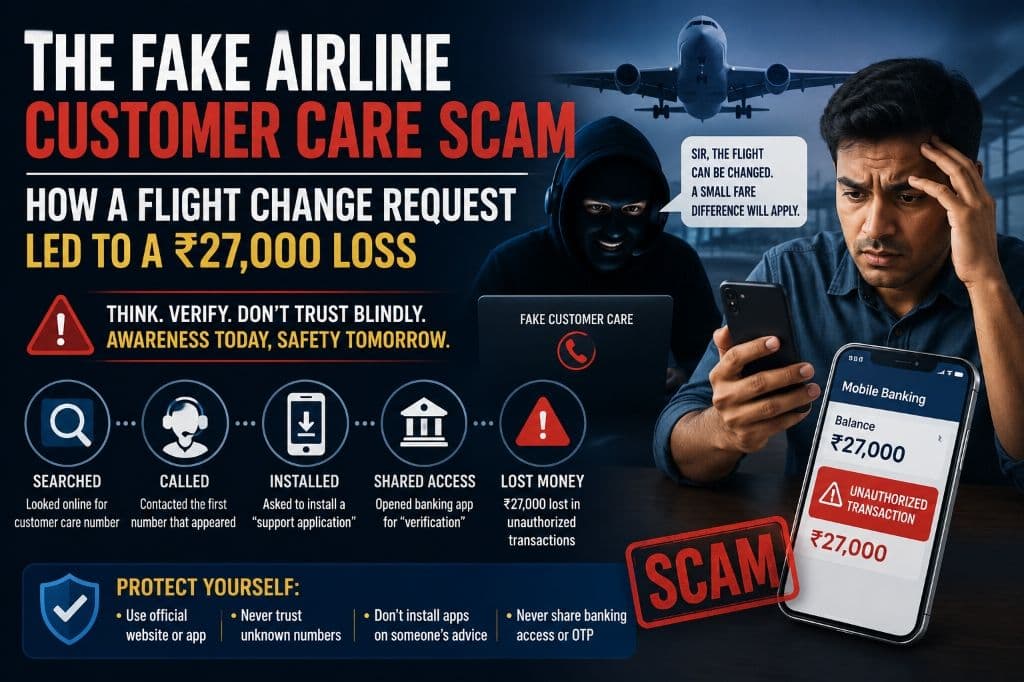
When Karan needed to reschedule a domestic flight, he searched online for the airline’s customer care number.

When Arvind booked a hotel through an online travel platform, the confirmation clearly showed ₹4,500 for one night, including taxes.