LOADING...
Focus: Food Safety | Consumer Rights | Regulatory Compliance | Responsible Marketing
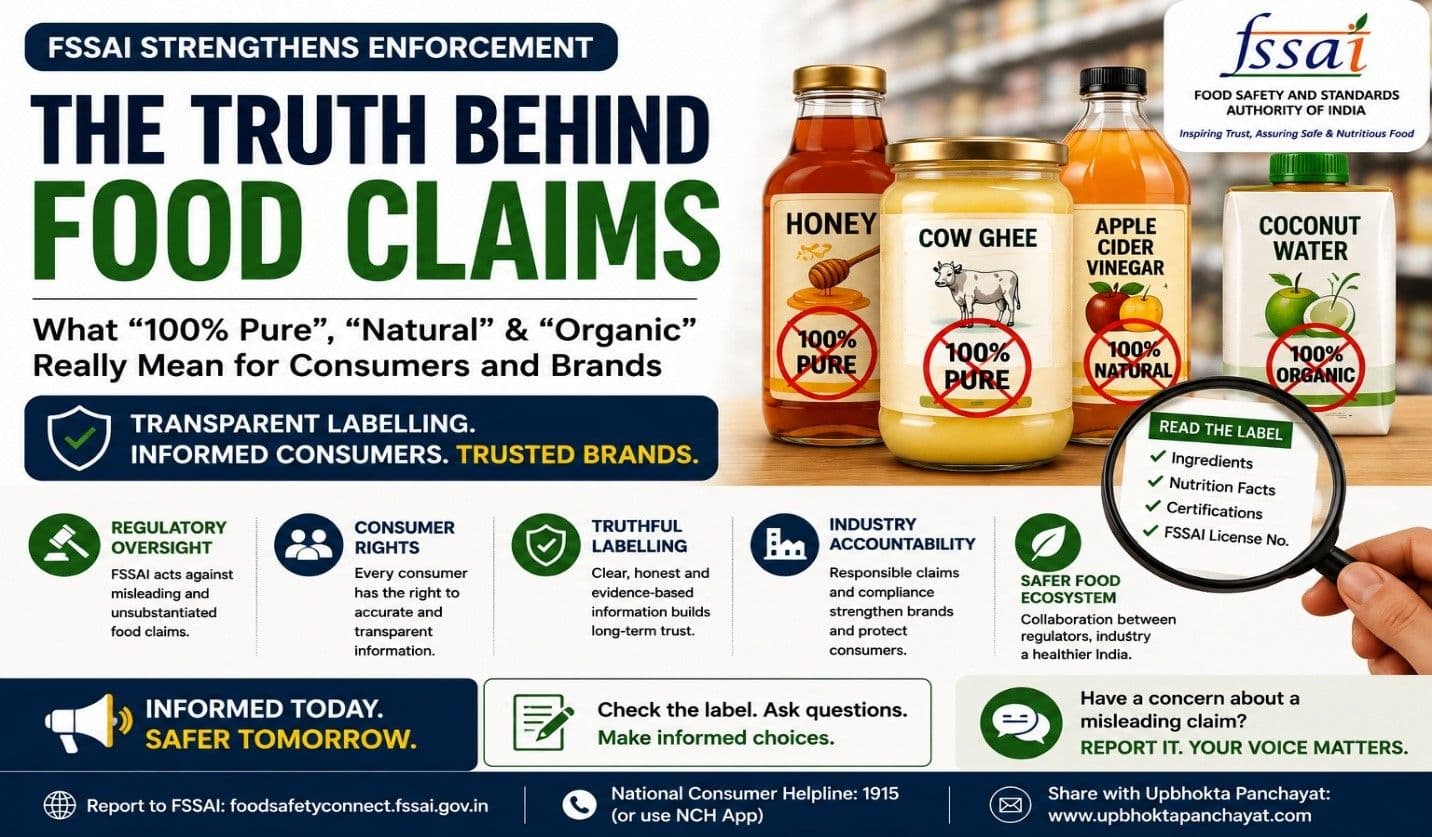
India's food and beverage market has witnessed remarkable growth over the past decade. Alongside this growth, terms such as "100% Pure," "100% Natural," "100% Organic," and "Purity Guaranteed" have become common marketing claims on packaged food products. These expressions often influence purchasing decisions by creating an impression of superior quality, authenticity, and safety.
Recent regulatory action by the Food Safety and Standards Authority of India (FSSAI) against certain packaged food products carrying "100%" claims has brought renewed attention to an important question: How should food companies communicate product claims, and what information do consumers have a right to expect?
The reported action, including directions involving certain products of Dabur India Ltd., has sparked a wider discussion on truthful labelling, substantiation of advertising claims, and consumer protection. Dabur has publicly stated that it is taking steps to comply with the regulator's directions while pursuing available legal remedies.
This discussion extends far beyond any single company. It highlights the need for stronger transparency, scientific substantiation of claims, and responsible communication across India's entire FMCG sector.
Why Are "100%" Claims Under Regulatory Scrutiny?
According to the Food Safety and Standards (Advertising and Claims) Regulations, 2018, food claims must be truthful, clear, scientifically supportable, and must not mislead consumers.
Absolute expressions such as:
can create very strong consumer perceptions. If such claims cannot be adequately substantiated or are likely to mislead consumers about the nature, composition, or processing of a product, regulators may require corrective action.
The objective is not merely to regulate advertising—it is to ensure that consumers make purchasing decisions based on accurate and transparent information.
Understanding the Legal Framework
India's food labelling regime is primarily governed by:
Together, these regulations seek to ensure that:
For food business operators, compliance is not limited to product quality—it also extends to how products are represented before consumers.
"Organic" Claims Require Regulatory Compliance
Products marketed as Organic must comply with applicable regulatory requirements and recognised certification systems. The use of organic-related claims or logos should be supported by valid certification and applicable legal requirements.
Consumers should therefore verify organic labels instead of relying solely on front-of-pack promotional claims.
Why Transparent Labelling Matters
Product labels represent one of the most important sources of information available to consumers.
A transparent label should enable consumers to understand:
When promotional claims create expectations that are not adequately supported by product information, consumer confidence can be affected.
Transparent communication benefits both consumers and responsible businesses.
Why Trusted Brands Carry Greater Responsibility
Companies with decades of consumer trust occupy a unique position in the marketplace.
Millions of consumers—particularly in rural and semi-urban India—often rely on the reputation of established brands while making purchasing decisions.
With such trust comes greater responsibility.
Strong brands are expected to lead through:
Long-term consumer trust is built not only through product quality but also through honesty and transparency.
What This Means for Consumers
The recent regulatory developments reinforce an important message:
Consumers should never rely exclusively on advertising slogans or front-of-pack claims.
Instead, they should:
An informed consumer is the strongest defence against misleading marketing practices.
Consumer Rights Under Indian Law
The Consumer Protection Act, 2019 recognises consumers' right to receive accurate information about products and services.
Consumers have the right to expect:
These rights form the foundation of an accountable marketplace.
Responsible Marketing: A Business Imperative
Responsible marketing goes beyond legal compliance.
It reflects a company's commitment to ethical business practices and long-term consumer trust.
Responsible businesses should ensure that:
Such practices strengthen both corporate reputation and consumer confidence.
Consumer Action Guide
Before purchasing packaged food products:
✔ Read the ingredient list carefully.
✔ Check nutrition information.
✔ Verify applicable certifications for specialised claims such as organic products.
✔ Read the entire label instead of relying only on promotional statements.
✔ Preserve invoices for future reference.
If consumers believe that product claims are misleading, they may report concerns through the appropriate regulatory or consumer grievance mechanisms, including the FSSAI complaint platform and the National Consumer Helpline.
Upbhokta Panchayat's View
Upbhokta Panchayat believes that consumer confidence grows when transparency becomes the industry standard.
Food businesses should view regulatory compliance not merely as a legal obligation but as an opportunity to strengthen public trust.
Similarly, regulators play a vital role in maintaining fairness across the marketplace by encouraging truthful communication and protecting consumers from potentially misleading claims.
Constructive engagement between regulators, industry, scientists, consumer organisations, and responsible businesses is essential for building a stronger food safety ecosystem.
Conclusion
The recent regulatory developments concerning "100%" food claims should be viewed as an opportunity to improve consumer awareness and strengthen transparency across India's packaged food industry.
Rather than focusing on any individual company, the larger lesson is that truthful labelling, evidence-based advertising, regulatory compliance, and informed consumer choice are essential pillars of a healthy marketplace.
As India's food sector continues to evolve, sustained collaboration between regulators, manufacturers, consumer organisations, and the public will help create a marketplace built on trust, transparency, accountability, and informed choice.
Disclaimer:This article is intended solely for consumer awareness and public education. It is based on publicly reported regulatory developments and the applicable legal framework. References to any company are made only in the context of publicly reported regulatory actions. The article does not make findings of wrongdoing beyond what has been publicly reported or officially communicated. Upbhokta Panchayat welcomes responses, clarifications, or corrections from regulators, companies, and other stakeholders in the interest of balanced and informed public discourse.
Six Workshops. Six Padyatras. Six Locations. One Mission to Strengthen Investor Protection at the Grassroots.