LOADING...
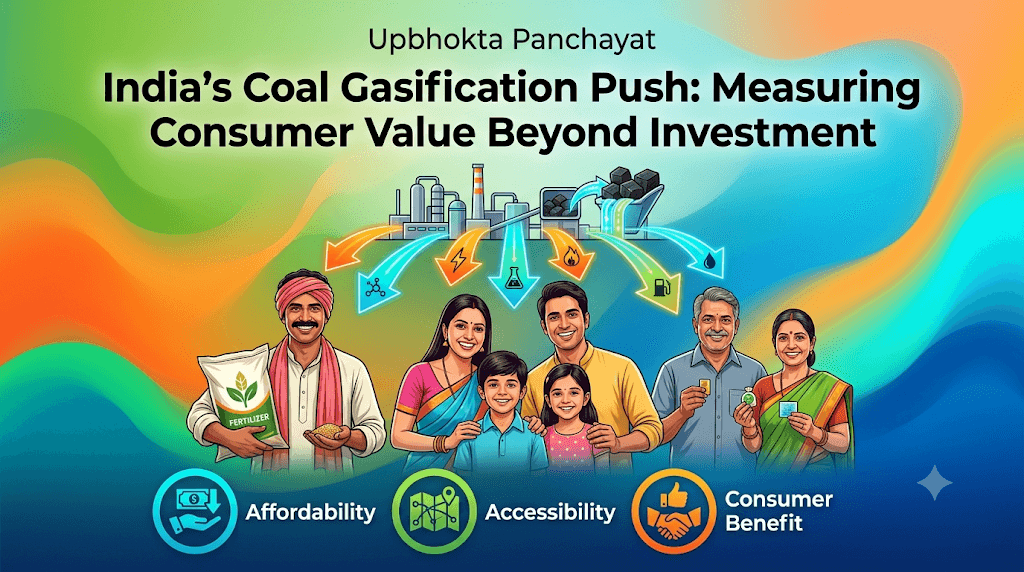
A Consumer-Centric Research Perspective on India’s ₹37,500 Crore Gasification Programme, Import Substitution and the Emerging Coal-to-Value Chain
India is entering a new phase in its coal and lignite utilisation strategy.
For decades, coal has largely been associated with electricity generation and conventional industrial use. The policy direction is now moving towards converting coal into higher-value products through gasification—creating syngas that can serve as a feedstock for products such as methanol, ammonia, hydrogen, synthetic natural gas and other chemicals.
The scale of the policy ambition is significant.
In May 2026, the Union Cabinet approved the Scheme for Promotion of Surface Coal/Lignite Gasification Projects with a financial outlay of ₹37,500 crore. The programme is intended to accelerate India’s coal gasification mission, support the target of gasifying 100 million tonnes of coal by 2030, strengthen energy security and reduce dependence on imports.
But as India moves from policy announcement towards project implementation, a broader question deserves attention:
How much of the economic value created through coal gasification will ultimately reach consumers, farmers and the wider economy?
This is not simply a question of technology.
It is a question of value creation, cost efficiency, import substitution, market competition and benefit transmission.
From Coal Utilisation to Coal Value Addition
Coal gasification changes the traditional economic pathway of coal.
Instead of using coal primarily as a fuel, gasification converts it into syngas, which can subsequently become an input for several industrial products.
The emerging value chain can broadly be represented as:
Coal/Lignite → Gasification → Syngas → Methanol/Ammonia/Hydrogen/SNG/Chemicals → Industry → Agriculture & Manufacturing → Consumer
This distinction is important.
The success of the programme should not therefore be assessed only by the quantity of coal gasified.
The more meaningful question is:
How much additional economic value is created per unit of coal, and where does that value ultimately go?
That is where the consumer perspective becomes relevant.
The ₹37,500 Crore Question
The government's new scheme represents a substantial policy intervention to accelerate commercial-scale gasification.
The stated objectives include reducing import dependence on products such as LNG, urea, ammonia and methanol. According to the government, India currently imports more than 50% of its LNG requirement, around 20% of urea, nearly 100% of ammonia and approximately 80–90% of methanol.
This creates a potentially significant opportunity.
If domestic coal gasification can competitively replace a portion of these imports, India could potentially reduce exposure to international commodity prices, geopolitical disruptions and foreign exchange volatility.
But import substitution is not automatically the same as consumer benefit.
There is a crucial economic link between the two.
If domestic production reduces the cost of an industrial input but the resulting benefit is absorbed elsewhere in the value chain, the consumer may see little or no direct advantage.
Therefore, the real policy question should be:
How will import substitution translate into measurable domestic economic and consumer value?
Government Estimates Point to a Large Economic Opportunity
The scale of the planned transformation is becoming clearer.
As of July 2026, approximately 22.6 million tonnes per annum (MTPA) of coal gasification capacity was reported as operational or under implementation. This included Jindal Steel's approximately 8 MTPA operational capacity, Talcher Fertilisers' approximately 2.6 MTPA project under implementation and around 12 MTPA across eight projects supported under the earlier ₹8,500 crore financial incentive scheme.
The new ₹37,500 crore scheme is expected to utilise approximately 75 MTPA of coal, substantially contributing towards the 100 MT national target for 2030.
The Ministry of Coal has also stated that once projects under the existing and new schemes, along with Talcher Fertilisers, are commissioned, import substitution from coal/lignite gasification could be around ₹1.5 lakh crore annually.
These are substantial numbers.
However, they also create an important requirement:
The economic impact of this transformation needs to be measured beyond project investment and import-substitution figures.
What Does This Mean for the Consumer?
The consumer impact of gasification may not always be immediate or visible.
A household may never directly purchase a “gasified coal” product.
Instead, the benefits—if realised—could travel through multiple sectors.
1. Fertiliser and Agriculture
Ammonia and urea are critical components of the fertiliser value chain.
If domestic production of feedstock becomes more competitive and less vulnerable to international price movements, the agricultural economy could potentially benefit through greater supply security and reduced exposure to external shocks.
The important question, however, is whether efficiency gains are actually transmitted through the fertiliser value chain.
2. Chemicals and Manufacturing
Methanol, ammonia, hydrogen and other gasification-derived products can serve as industrial feedstocks.
Lower or more stable input costs could improve the competitiveness of Indian manufacturing.
The consumer benefit could then emerge indirectly through:
3. Energy Security
India's dependence on imported energy makes the economy vulnerable to global price movements.
Domestic conversion of coal into value-added energy products could provide another source of supply diversification.
However, the consumer value of energy security should be assessed in terms of price stability and reliability, not merely import volumes.
4. Employment and Regional Development
Large gasification projects can create direct employment as well as demand for engineering, construction, logistics, operations and ancillary services.
Coal-producing regions could potentially become centres of downstream industrial activity rather than remaining primarily suppliers of raw coal.
Again, the relevant question is not simply how many jobs are created, but what quality of employment and local economic value is generated.
Investment Alone Is Not the Consumer Benefit
One of the biggest risks in evaluating a new industrial technology is to equate investment with public benefit.
Large investment is important.
New technology is important.
Industrial capacity is important.
But the ultimate economic test is value creation relative to cost.
For coal gasification, this means evaluating at least five dimensions:
Parameter What Should Be Measured?
Economic Viability Cost of gasification and downstream products
Import Substitution Actual reduction in import dependence
Industrial Competitiveness Impact on domestic input costs
Consumer Transmission Whether cost efficiencies reach end-users
Environmental Performance Emissions, water use and waste management
Such a framework could help move the national discussion from “How much are we investing?” to “What are we getting in return?”
The Next Phase Is Implementation
India's gasification programme is no longer limited to policy announcements.
The Ministry of Coal launched the online application portal for the ₹37,500 crore scheme in July 2026. It has also initiated processes relating to project management, pre-application consultations and project applications. In August, the Ministry published consolidated responses to pre-application queries, indicating that the programme is moving towards actual project development.
This transition—from policy to projects—is particularly important.
The next few years will determine:
This is also the stage at which independent research and industry dialogue become increasingly important.
Technology Will Determine the Economics
Gasification is not a single technology with a single cost structure.
Project economics can vary depending on coal quality, gasification technology, scale, feedstock characteristics, downstream product, water availability, infrastructure and financing costs.
Therefore, comparing projects only on installed capacity would provide an incomplete picture.
A meaningful assessment should consider:
Feedstock → Technology → Conversion Efficiency → Product Yield → Capital Cost → Operating Cost → Environmental Cost → Final Product Competitiveness
This is particularly important for consumer-oriented analysis because ultimately the economics of the upstream process influence the price and competitiveness of the downstream product.
The Environmental Dimension Cannot Be Ignored
Coal gasification is being promoted as a pathway for higher-value utilisation of domestic coal and as part of India's energy-security and industrial strategy.
However, higher-value utilisation should not mean that environmental considerations become secondary.
Project-level assessment of emissions, water consumption, waste management, land requirements, carbon intensity and process efficiency will remain important.
For consumers, environmental performance is not an abstract issue.
Environmental costs can eventually become economic costs—through resource stress, remediation requirements, regulatory compliance and public expenditure.
Therefore, a genuinely future-ready gasification ecosystem should seek to optimise economic efficiency and environmental performance together.
A New Consumer Metric for Gasification
India's gasification programme could benefit from a broader performance framework.
Instead of measuring success only through:
Coal Gasified + Investment + Capacity
a more comprehensive framework could be:
Gasification Value Index
**Energy Security
Such a framework would not replace technical or financial project evaluation.
It would complement it.
The purpose would be to answer a simple but important question:
Is the economic value generated by gasification large enough, efficient enough and widely distributed enough to justify the scale of the national transition?
Why Industry–Consumer Dialogue Matters
India's gasification ecosystem is now entering a phase where policymakers, coal producers, technology providers, project developers, EPC companies, investors and researchers will increasingly need to work together.
Industry platforms that bring these stakeholders together can play an important role in shaping the next phase of the sector.
Mission Energy Foundation's Gasification India 2026, scheduled for 22–23 October 2026 in New Delhi, is positioned around precisely this transition—advancing policy, accelerating projects, enabling technology and building partnerships as India moves towards commercial deployment of coal and lignite gasification.
From a consumer-interest perspective, this wider industry dialogue also creates an opportunity to ask a complementary question:
How can India's gasification transformation be designed so that the value created by the industry is ultimately reflected in broader economic and consumer outcomes?
This is not an argument against industrial development.
It is an argument for measuring its impact more completely.
From “Coal to Gas” to “Coal to Value”
India's coal gasification programme represents a significant shift in the way domestic coal resources may be utilised.
The government's ₹37,500 crore programme, the 100 MT 2030 target, projects already operational or under implementation and the expected scale of import substitution indicate that the sector could become an important component of India's future industrial economy.
But the real test will begin when projects move from announcements and construction to commercial operation.
Will the technology deliver competitive products?
Will import dependence actually fall?
Will domestic industry become more competitive?
Will farmers and manufacturing sectors benefit?
Will consumers see greater price stability or affordability?
And will environmental performance keep pace with industrial ambition?
These questions deserve to be tracked systematically.
The next chapter of India's gasification story should therefore not be measured only in tonnes of coal gasified. It should also be measured in the economic value created, the imports avoided, the industries strengthened and the benefits ultimately reaching consumers.
For India, the journey may be from Coal to Gasification.
For the consumer, the real journey must be:
Coal → Value → Competitiveness → Affordability → Consumer Benefit.
Research Perspective | Upbhokta Panchayat
This article presents an independent consumer-centric perspective on India's emerging coal and lignite gasification ecosystem. It seeks to encourage evidence-based dialogue on economic value creation, industrial competitiveness, energy security and consumer outcomes.
Six Workshops. Six Padyatras. Six Locations. One Mission to Strengthen Investor Protection at the Grassroots.