LOADING...
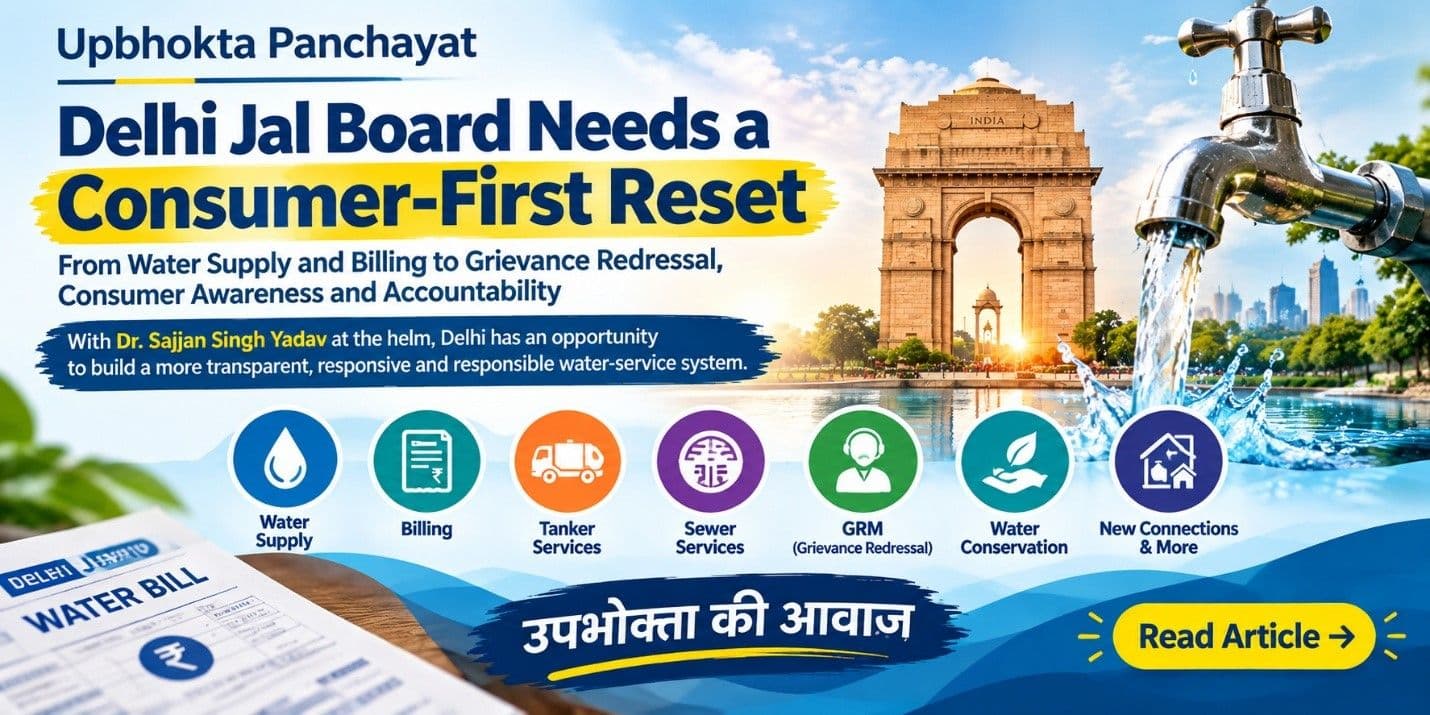
With Dr. Sajjan Singh Yadav at the helm, Delhi has an opportunity to build a more transparent, responsive and consumer-centric water-service system
For millions of residents, the Delhi Jal Board (DJB) is much more than a government agency. It is the public utility responsible for services that touch some of the most basic requirements of everyday life—water supply, water connections, sewerage, billing, water tankers, drainage-related issues, rainwater harvesting and several related public-service functions.
That makes the quality of the consumer experience as important as the infrastructure itself.
A water utility can build treatment plants, lay pipelines and expand its distribution network. But from a consumer's perspective, the real test begins much closer to home:
Does the water reach the household reliably?
Is the meter reading correct?
Is the bill understandable and accurate?
Can a new connection be obtained without unnecessary difficulty?
What happens when there is no water, contaminated water, a leakage, a sewer blockage or waterlogging?
And most importantly—if a consumer raises a complaint, is there a transparent and time-bound system to get it resolved?
These questions place consumer service, grievance redressal and consumer awareness at the centre of public-utility reform.
Delhi Jal Board is now entering an important phase under the leadership of Dr. Sajjan Singh Yadav, IAS (AGMUT:1995), who joined as CEO on 10 June 2026 and is currently listed as the Board's Chief Executive Officer.
For Delhi's consumers, this transition provides an opportunity to look beyond individual complaints and ask a larger policy question:
Can Delhi Jal Board become a genuinely consumer-first public utility?
The answer will depend not only on water infrastructure, but on how effectively DJB connects service delivery, billing, communication, grievance redressal, consumer education and accountability.
A consumer's relationship with DJB is much bigger than a water bill
Public discussion around DJB often focuses on billing.
Billing is certainly important. But it is only one part of the consumer journey.
A typical DJB consumer may interact with the Board for:
DJB's official website itself identifies Rain Water Harvesting/Ground Water Management, Water, Water Billing, Drainage and Water Tanker among its major service areas.
This is why a consumer-first reform agenda should not be reduced to the question of whether a bill was generated correctly.
The real objective should be:
Every interaction between DJB and a consumer should be simple, transparent, trackable and accountable.
1. Reliable water supply is the first consumer right
For a water utility, the most fundamental consumer expectation is obvious:
Water should be available when and where it is supposed to be available.
DJB states that it has an extensive water-supply network serving Delhi through treatment plants, booster pumping stations and thousands of kilometres of water mains and distribution infrastructure.
Yet the consumer experience can vary considerably across neighbourhoods.
Supply interruptions, low pressure, local breakdowns, leakage, summer shortages and dependence on tankers can significantly affect households.
Therefore, a modern consumer-service approach should provide consumers with timely information about:
The consumer should not have to discover a supply disruption only after turning on the tap.
Upbhokta Panchayat recommendation
DJB should progressively develop a consumer-facing water-supply information system in which affected consumers can receive localised alerts through SMS, WhatsApp, mobile applications and other appropriate digital channels.
The objective should be simple:
If DJB knows that a disruption is occurring, consumers should know too.
2. New water connections should be simple, transparent and time-bound
A new water connection is another important consumer interaction.
DJB provides procedures for new water and sewer connections, and its published decision-making process specifies stages such as receipt of application, diary number, forwarding to the concerned ZRO, site inspection, sanction and allotment.
The existence of a defined process is positive.
But from the consumer's perspective, a process is useful only when the applicant can easily understand:
Where do I apply?
What documents are required?
What is the applicable fee?
Who is responsible for the next step?
What is the expected timeline?
What happens if the application is delayed?
DJB's published FAQs indicate that applications for new water and sewer connections can be submitted through the consumer portal or through the concerned Zonal Revenue Office.
The next generation of consumer service should therefore move further towards end-to-end application tracking.
Upbhokta Panchayat recommendation
Every application should ideally have a unique reference number through which the applicant can see:
Application received → Documents verified → Inspection scheduled → Inspection completed → Approval pending → Connection sanctioned → Connection released
This would reduce unnecessary visits and make accountability much easier.
3. Water meters are central to fair billing
The meter is effectively the bridge between consumption and the bill.
A faulty, stuck, leaking or incorrectly read meter can therefore become the starting point of a billing dispute.
DJB's own complaint documentation recognises several meter-related issues, including:
This demonstrates why meter management should be treated as a core consumer-protection issue.
What should consumers expect?
Consumers should have easy access to:
Where technically feasible, DJB should increasingly move towards digitised meter reading and photographic/geotagged verification, particularly in cases involving disputed consumption.
The objective is not technology for its own sake.
The objective is:
A bill should be explainable.
4. Billing must become simpler, more regular and more transparent
Billing is one of the most visible areas of consumer interaction with DJB.
DJB's current consumer contact information specifically provides channels for water bills, billing, meter reading, wrong bills, access to bills and new water connections.
Its complaint form also recognises a broad range of billing-related grievances, including:
This is important because it shows that billing is not a single problem.
It is a chain of consumer-service issues.
A consumer-first bill should therefore clearly explain:
Previous reading → Current reading → Consumption → Applicable charges → Sewerage-related charges → Other charges → Arrears, if any → Due date → Payment options
Consumers should not need specialist knowledge to understand why a particular amount has been demanded.
5. A high bill needs a simple dispute-resolution route
A suddenly high water bill can create anxiety for a household.
Sometimes the increase may be genuine—for example, because of increased consumption, leakage or accumulated dues.
But sometimes the consumer may suspect:
The answer should not be an automatic confrontation between consumer and utility.
There should be a clear verification mechanism.
A better high-bill protocol
For significantly abnormal consumption, DJB could consider an automated consumer alert:
“Your current consumption is substantially higher than your previous recorded consumption. Please verify your meter reading. If you believe the reading or bill is incorrect, raise a billing/meter complaint.”
Such an approach can prevent disputes before they become formal grievances.
6. Sewerage is also a consumer service—not merely an engineering function
Consumer discussions about DJB often focus on drinking water and overlook sewerage.
For residents, however, sewerage problems can be just as disruptive.
These include:
DJB's sewer-connection guidance specifically addresses consumer requirements, connection procedures and precautions for sewer maintenance. It also advises consumers against putting paper, plastic, clay, grit, sand and other material into sewer systems because these can cause blockages.
This is an important area where consumer responsibility and public-service responsibility must work together.
DJB must maintain the network.
Consumers must use the network responsibly.
7. Water quality and contamination complaints need priority treatment
Water contamination is not an ordinary service complaint.
If consumers suspect contaminated water, the issue has immediate public-health implications.
DJB's grievance mechanism recognises water contamination as a specific complaint category.
Such complaints should therefore receive priority treatment with:
A consumer should never be left wondering whether the water supplied to the household is safe.
8. Water tankers are an important consumer service in deficit areas
Water tankers are an important part of Delhi's water-service ecosystem, particularly in water-deficit areas and during periods of short supply.
DJB states that it supplies potable water through departmental and hired tankers in areas without piped connections and during situations such as major breakdowns or additional summer demand. It also refers to GPS-enabled hired tankers as part of its tanker-management system.
For consumers, transparency is critical.
A tanker request should ideally allow the consumer to know:
Where GPS-enabled tankers are deployed, this technology should increasingly be used to improve transparency and reduce uncertainty.
9. Waterlogging and drainage complaints require integrated response
Delhi's monsoon-related waterlogging problem adds another dimension to public utility management.
The current DJB contact page specifically lists waterlogging among the issues for which consumers can seek assistance, alongside water bills, water problems, tankers, sewer problems and illegal boring.
For consumers, however, institutional boundaries are less important than the outcome.
They want to know:
Who will respond?
How quickly?
What action has been taken?
Has the waterlogging actually been resolved?
A consumer-first system should therefore focus on issue ownership, even when resolution requires coordination between multiple agencies.
10. Rainwater harvesting should become part of consumer awareness
Delhi's water future cannot depend entirely on conventional water supply.
Rainwater harvesting and groundwater management therefore deserve a stronger consumer-facing approach.
DJB provides information on rainwater harvesting, groundwater management, illegal groundwater extraction, technical assistance and related initiatives.
DJB's published guidance also recognises incentives associated with functional rainwater harvesting and wastewater-recycling systems for eligible properties.
This is an area where consumer awareness can directly support public policy.
Consumers should understand:
The message should be:
Water conservation is not only government's responsibility. It is also a consumer responsibility.
11. Grievance Redressal must become the backbone of consumer service
This is perhaps the most important area for reform.
DJB already has multiple channels for complaints.
Its official information currently identifies 1916 / 1800117118, WhatsApp, the Control Command Centre, concerned ZRO/Jt./Dy. Director channels and other mechanisms for different categories of consumer problems.
The official grievance mechanism also describes complaints through water emergencies, the Central Control Room, government grievance platforms and other channels.
DJB's complaint system provides a complaint reference number, which consumers can use to track the status of complaints.
These are important foundations.
But a modern GRM should go beyond “complaint registered”.
The consumer needs to know:
Who is handling my complaint?
What action has been taken?
What is the expected resolution date?
What happens if the complaint is not resolved?
How can I escalate it?
Can I confirm whether the issue was actually resolved?
12. The ideal DJB Consumer GRM
A strong consumer grievance mechanism should follow a simple chain:
Complaint
Consumer registers the issue through phone, WhatsApp, website, app or local office.
↓
Acknowledgement
Consumer receives a unique complaint/reference number.
↓
Classification
Complaint is automatically categorised—for example:
Water Supply | Billing | Meter | Sewer | Tanker | Leakage | Contamination | Waterlogging | Connection | Other
↓
Assignment
Complaint is assigned to the responsible official/team.
↓
Time limit
A service-specific resolution timeline is communicated.
↓
Status tracking
Consumer can see whether the complaint is:
Received → Assigned → Under Investigation → Action Taken → Resolved
↓
Consumer confirmation
Consumer gets an opportunity to confirm whether the issue has actually been resolved.
↓
Escalation
If unresolved, the complaint automatically moves to the next level.
↓
Final closure
Complaint should be closed only after the required action has been recorded.
This is the difference between a complaint registration system and a genuine grievance-redressal mechanism.
13. DJB already has an escalation structure—but it should become easier for consumers to understand
DJB's published water-service information describes escalation from the concerned ZRO to higher officers when a grievance is not resolved within the prescribed time. It also identifies revenue-related escalation channels.
The broader grievance mechanism also describes escalation through government grievance platforms and indicates that complaints on the Chief Minister's grievance system that remain unattended for 21 days may be taken up suo motu by the Public Grievances Commission.
This demonstrates that an escalation architecture exists.
The consumer challenge is discoverability and simplicity.
A consumer should not have to search through multiple pages of a government website to determine:
“My complaint has not been resolved. What is my next step?”
Upbhokta Panchayat recommendation
DJB should publish a simple “If your complaint is not resolved” consumer guide showing:
Level 1 → Level 2 → Level 3 → External grievance mechanism
along with:
14. Multiple complaint channels should ultimately feel like one system
DJB consumers can encounter multiple channels—1916, WhatsApp, online systems, water emergencies and government grievance platforms.
Multiple channels are useful.
But multiple channels should not mean multiple disconnected databases.
A consumer who complains through WhatsApp should ideally be able to track the same complaint through another approved channel.
The future should therefore be:
One Consumer Complaint ID — Multiple Access Channels
Whether the consumer uses:
Phone | WhatsApp | Website | App | Water Emergency | Government Grievance Portal
the underlying complaint should ideally remain traceable through a common reference number.
15. Consumer education should become a permanent DJB programme
A sophisticated grievance mechanism alone cannot solve every problem.
Many disputes can be prevented through better consumer awareness.
Consumers should regularly receive simple information on:
This information should not remain buried inside government webpages.
It should reach consumers where they live.
Potential partners
DJB can work with:
The objective should be:
An informed consumer is better equipped to prevent disputes, identify genuine problems and use the grievance system effectively.
16. Consumer rights must be balanced with consumer responsibilities
Consumer protection should not be interpreted as consumer exemption from responsibility.
A fair relationship requires responsibilities on both sides.
DJB's responsibility
Reliable service.
Accurate measurement.
Correct billing.
Transparent communication.
Accessible complaint channels.
Time-bound grievance redressal.
Clear escalation.
Consumer's responsibility
Pay genuine bills on time.
Do not tamper with meters or connections.
Use water responsibly.
Do not dispose of waste into sewer lines.
Report leakage and contamination promptly.
Do not misuse tanker or emergency services.
Use the formal grievance mechanism when a genuine problem arises.
This shared-responsibility model can help build a healthier relationship between DJB and its consumers.
17. Digitalisation should simplify—not complicate—the consumer's life
DJB has already developed multiple digital and telephone-based consumer interfaces.
The next stage should be integration.
A future consumer dashboard could ideally bring together:
My Water Account
My Meter
My Applications
My Complaints
My Locality
Such a system would convert DJB's digital presence from an information repository into a genuine consumer-service platform.
18. DJB should publish consumer-service performance indicators
A public utility should be measured not only by infrastructure created.
It should also measure the quality of service experienced by consumers.
DJB should consider publishing a periodic Consumer Service Performance Dashboard covering indicators such as:
This would allow citizens to evaluate service delivery using evidence rather than anecdote.
19. Complaint closure should not be the same as complaint resolution
This distinction deserves special attention.
A complaint can be marked “closed” in a database.
But that does not necessarily mean the consumer's problem has disappeared.
For example:
A sewer complaint may be marked resolved because a team visited the location.
But if the blockage returns two days later, the consumer has not experienced a real resolution.
Similarly:
A billing complaint may be closed after a response is uploaded.
But if the disputed bill remains unchanged without adequate explanation, the consumer may still be dissatisfied.
Therefore, DJB should increasingly measure:
Resolution from the consumer's perspective
rather than simply:
Administrative closure
Consumer feedback after closure can help distinguish the two.
20. The opportunity before the new CEO
The appointment of Dr. Sajjan Singh Yadav comes at an important time for DJB.
Official records confirm that he assumed charge as CEO on 10 June 2026.
The opportunity before the new leadership is therefore not limited to infrastructure expansion.
It is an opportunity to make the consumer experience itself a measurable governance priority.
The question should move from:
“How many projects have been completed?”
to a broader set of questions:
How many consumers receive timely bills?
How many billing disputes are resolved within defined timelines?
How quickly are water-supply complaints addressed?
How many tanker requests are completed within the expected period?
How quickly are contamination complaints investigated?
How many new connections are processed within the published timeline?
How many complaints are reopened by consumers?
How satisfied are consumers after resolution?
These are not secondary indicators.
They are indicators of public-service quality.
21. Ten-point Consumer-First Reform Agenda for Delhi Jal Board
From the consumer perspective, Upbhokta Panchayat recommends the following priorities:
1. Create a unified DJB Consumer Service Charter
Clearly publish services, timelines, responsible authorities and escalation mechanisms.
2. Establish one integrated complaint ID
Complaints submitted through different approved channels should remain traceable through a common reference number wherever technically feasible.
3. Make billing fully transparent
Consumers should be able to understand readings, consumption, charges, arrears and other components of their bill.
4. Strengthen meter governance
Digitised readings, verification mechanisms and consumer access to consumption history should be expanded.
5. Introduce service-specific grievance timelines
A billing dispute, contamination complaint, sewer blockage and water-supply emergency should not necessarily follow the same resolution timeline.
6. Create a visible escalation ladder
Every consumer should know exactly what to do if the first complaint is not resolved.
7. Introduce consumer-confirmed closure
A complaint should not be considered fully resolved merely because an internal status has been changed.
8. Build a permanent consumer-awareness programme
Consumer education should cover billing, connections, sewerage, tanker services, water conservation, rainwater harvesting and grievance redressal.
9. Publish Consumer Service Performance Reports
DJB should periodically disclose key service-quality indicators.
10. Build partnerships with consumer organisations
Consumer organisations, RWAs and community institutions can help DJB identify recurring problems and take consumer education to neighbourhood level.
The goal should be: “Responsive DJB, Responsible Consumer”
The relationship between a public utility and its consumers should not be adversarial.
It should be based on:
Service.
Transparency.
Accountability.
Awareness.
Shared responsibility.
DJB's responsibility is to provide reliable services, correct billing, transparent communication and accessible grievance redressal.
The consumer's responsibility is to pay genuine bills on time, conserve water, protect public infrastructure, report genuine problems and use established grievance mechanisms.
Neither side can achieve a sustainable system alone.
A larger opportunity for Delhi
Delhi's water challenge is too important to be viewed only through the lens of infrastructure.
The city needs a consumer-service ecosystem around its water infrastructure.
That ecosystem should connect:
Water Supply
↓
Connections
↓
Metering
↓
Billing
↓
Sewerage
↓
Tankers
↓
Water Quality
↓
Drainage & Waterlogging
↓
Rainwater Harvesting & Conservation
↓
Grievance Redressal
↓
Consumer Awareness
↓
Consumer Feedback
This is the complete consumer journey.
If these elements work together, DJB can move towards a model of public utility management where consumers are not merely bill payers or complaint numbers.
They become informed participants in the system.
The Upbhokta Panchayat View
Delhi does not merely need a stronger water infrastructure.
It needs a stronger consumer-service system around that infrastructure.
The true test of a public utility is not only how much water it produces or distributes.
It is also:
How transparently it communicates.
How accurately it measures consumption.
How fairly it bills.
How easily consumers can access its services.
How quickly it responds to problems.
How effectively it resolves grievances.
How clearly it explains escalation.
And how successfully it enables consumers to become informed and responsible partners.
The current phase of leadership at Delhi Jal Board provides an opportunity to make this consumer-first approach an integral part of public-service reform.
For Upbhokta Panchayat, consumer advocacy is not about criticising a public institution for the sake of criticism.
It is about asking practical questions, identifying systemic gaps and proposing solutions that can improve the experience of both the consumer and the service provider.
A more transparent billing system can reduce disputes.
A stronger grievance mechanism can reduce repeated complaints.
Better consumer education can prevent avoidable problems.
Better digital communication can reduce unnecessary office visits.
And stronger consumer feedback can help management identify where service delivery is actually falling short.
Ultimately, the objective should be straightforward:
A Responsive DJB and a Responsible Consumer.
That is not merely a consumer-protection objective.
It is a public-service governance objective for Delhi.