LOADING...
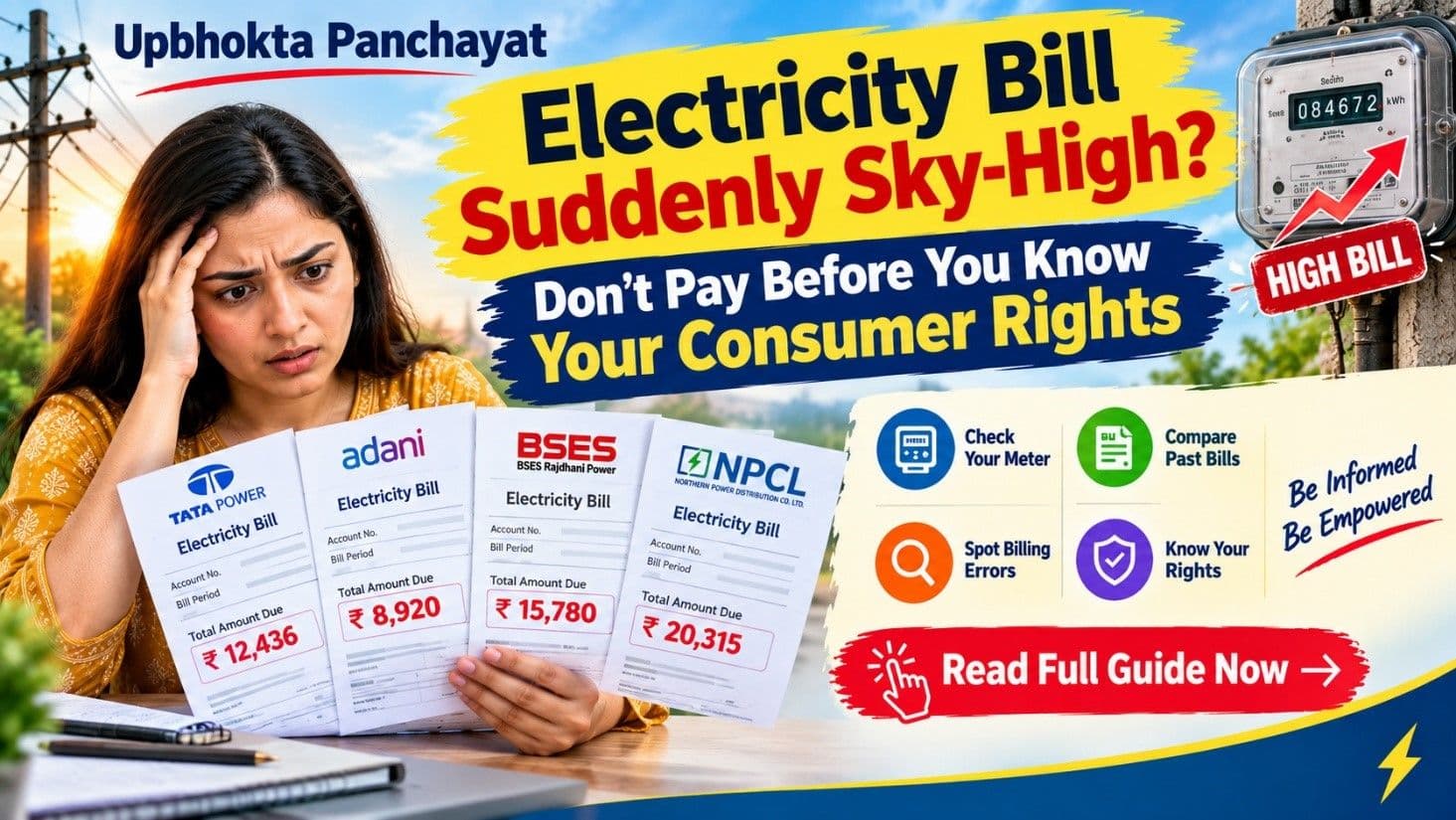
A Wrong Meter Reading, Unexplained Arrears or a Bill Several Times Higher Than Usual Can Leave Any Family Worried. Here’s What Consumers Should Check—and What They Can Do.
Imagine opening your electricity bill expecting an amount of ₹2,000–₹3,000.
Instead, the bill shows ₹8,000, ₹12,000 or even ₹20,000.
Your first reaction may be simple:
“How can this be possible?”
You check your appliances. Nothing major has changed. Your family's electricity usage appears normal. Yet the amount payable has suddenly jumped.
For many consumers, the natural response is to either pay the bill out of fear of disconnection—or spend days trying to understand where the extra amount came from.
But an unusually high electricity bill should not simply be accepted without checking.
It should first be understood, verified and, where necessary, disputed through the proper grievance mechanism.
That is why Upbhokta Panchayat believes every electricity consumer should know what to check when a bill suddenly becomes abnormal.
When an Electricity Bill Suddenly Doubles, What Should a Consumer Do?
A higher bill does not necessarily mean that the DISCOM has made an error.
Consumption may genuinely have increased because of air-conditioner usage, heating, additional appliances, longer operating hours or seasonal changes.
But there can also be other reasons:
The first mistake a consumer should avoid is looking only at the final amount.
The important question is:
How many units have actually been recorded, and how has that figure been calculated?
1. Check the Meter Before You Pay
The simplest first step is also one of the most important.
Look at the electricity meter installed at your premises.
Now compare the current meter reading with the reading printed on your electricity bill.
If there is a significant difference, take a clear photograph of the meter showing the reading and preserve it.
Also note the date.
A consumer should ideally maintain a basic record of:
Previous Reading → Current Reading → Units Consumed → Amount Billed
This simple comparison can immediately help identify whether the problem is related to consumption, reading or billing.
2. Don’t Look at Just One Bill—Compare the Previous Bills
Suppose your usual monthly consumption is around 250–300 units.
Suddenly, the bill shows 800 units.
That deserves a closer look.
Check your previous 3–6 electricity bills, where available.
Look for:
A sudden increase becomes easier to understand when the consumption history is placed side by side.
Consumer Tip
Do not compare only the rupee amount.
Compare the units consumed.
Tariff structures and charges can change, but an unexplained jump in consumption is something the consumer should investigate.
3. Actual Reading or Average Reading?
One detail that many consumers overlook is the basis on which the bill has been generated.
Consumers should check whether the bill reflects an:
Actual meter reading
or an
Average/estimated/provisional reading, where applicable.
If earlier bills were generated using estimated readings and a later bill is based on an actual reading, an adjustment may appear.
This does not automatically mean the bill is wrong.
But the consumer should be able to understand why the adjustment has been made and how the amount was calculated.
4. What If the Meter Is Suspected to Be Faulty?
Sometimes consumers say:
“Our electricity usage has not changed, but the meter seems to be recording much more consumption.”
A consumer should not attempt to open, alter or interfere with the meter.
Instead, the appropriate approach is to raise a formal complaint with the concerned electricity distribution company and, where necessary, request meter testing under the applicable procedure.
Keep the complaint number and all supporting documents.
If testing is conducted, ask for the result or report through the prescribed process.
Remember:
Never try to prove that a meter is faulty by physically interfering with it.
A formal testing and grievance process is the safer route.
5. What If an Old Arrear Suddenly Appears?
An electricity bill may sometimes contain terms such as:
If a consumer does not understand an amount, the consumer should ask the DISCOM for an explanation and supporting billing details.
Do not rely only on a verbal explanation.
Keep a record of:
A documented complaint is much stronger than a complaint based only on a telephone conversation.
6. What If the Bill Is Clearly Wrong?
If the consumer believes that the bill contains an incorrect reading, unexplained charge or other billing error, the first step should generally be to contact the concerned electricity distribution company.
Upbhokta Panchayat's own Complaint Directory lists electricity supply, billing, meter, outage and service-quality matters under the concerned State Electricity Distribution Company as the first point of complaint.
The consumer should:
Step 1
Register the complaint through the official channel.
Step 2
Clearly state why the bill appears incorrect.
Step 3
Attach supporting documents or photographs where the system permits.
Step 4
Obtain and preserve the complaint/reference number.
Step 5
Follow the status instead of relying on an informal assurance.
7. What If You Receive a Disconnection Warning?
This is where many consumers panic.
A consumer may receive a message or notice stating that electricity will be disconnected because of non-payment.
But before reacting, check:
The Electricity (Rights of Consumers) Rules, 2020 created a national framework covering areas including billing, metering, disconnection and reconnection, standards of performance and grievance redressal. The exact procedure applicable to a particular consumer can depend on the relevant State Electricity Regulatory Commission and DISCOM regulations.
Upbhokta Panchayat's advice:
Do not ignore a disconnection notice.
If the bill is disputed, raise the dispute formally and preserve the complaint reference and supporting evidence.
8. Can Electricity Be Disconnected Without Any Notice?
This is one of the questions consumers frequently ask.
The answer should not be reduced to a simple “yes” or “no”, because the applicable procedure depends on the reason for disconnection and the relevant regulatory framework.
Routine non-payment and emergency/safety-related situations may be treated differently.
Therefore, if a consumer receives a disconnection warning, the first question should be:
“What is the reason for disconnection, and what procedure applies to my connection?”
For ordinary billing-related disputes, consumers should carefully preserve any notice, SMS, email or other communication received from the DISCOM.
If electricity has already been disconnected and the consumer believes the procedure was not properly followed, the matter should be raised through the applicable grievance mechanism.
9. What If the DISCOM Does Not Resolve the Complaint?
A consumer complaint should not necessarily end with the first response from customer care.
The electricity consumer grievance framework provides escalation mechanisms.
Depending on the applicable state system, the route can involve:
DISCOM / Customer Care
↓
Consumer Grievance Redressal Forum (CGRF)
↓
Electricity Ombudsman
The exact process and timelines vary by state.
This is why consumers should always keep their original complaint number, bills, correspondence and other evidence.
10. Can a Consumer Claim Compensation?
Consumer protection is not only about getting a complaint number.
Electricity regulatory frameworks also provide standards of performance and, in applicable circumstances, compensation mechanisms.
However, consumers should not assume that every high bill automatically creates a right to compensation.
Whether compensation is available depends on:
Consumers should therefore check the applicable State Electricity Regulatory Commission regulations.
The 7 Things Every Consumer Should Do When the Bill Looks Abnormal
1. Photograph the meter
Record the reading and date.
2. Compare previous bills
Look at units, not just rupees.
3. Check the billing basis
See whether the bill reflects actual or estimated/average reading, where applicable.
4. Look for arrears and adjustments
Do not ignore unexplained entries.
5. File a written complaint
Use the official DISCOM channel.
6. Save the complaint number
This is your proof that the issue was formally raised.
7. Escalate if necessary
Use the applicable CGRF and Electricity Ombudsman mechanism.
What Consumers Should Never Do
Do not physically tamper with the meter.
Do not rely only on verbal promises.
Do not delete SMS, emails or complaint acknowledgements.
Do not ignore a disconnection notice.
Do not assume that a high bill is automatically correct—or automatically fraudulent.
The right approach is to verify first and complain formally where necessary.
Upbhokta Panchayat's Recommendations
Electricity is an essential service. Consumers may have little or no choice regarding which distribution company serves their locality.
That makes transparency even more important.
Upbhokta Panchayat recommends:
1. High-Bill Alerts
DISCOMs should consider automatic alerts when consumption shows an unusually large increase compared with a consumer's established pattern.
2. Clear Meter-Reading Disclosure
Bills should prominently identify whether the reading is actual or based on an applicable average/estimated methodology.
3. One-Click High-Bill Complaint
Every DISCOM website and mobile application should provide a clearly visible “High/Incorrect Bill” complaint option.
4. Transparent Meter Testing
Consumers should have a simple, trackable mechanism to request meter testing and receive the result.
5. Explain Every Adjustment
Arrears and adjustments should be accompanied by understandable details explaining how the amount was calculated.
6. Stronger Pre-Disconnection Communication
Consumers facing routine disconnection for non-payment should receive clear information about the outstanding amount, due date and applicable procedure through reliable communication channels, subject to the applicable regulations.
7. Protect Genuine Billing Disputes
The applicable regulatory framework should provide clear safeguards for consumers who have formally raised genuine billing disputes.
8. Make Complaint Tracking Mandatory
Every complaint should generate a unique reference number and provide a clear escalation route.
9. Put Grievance Information on Every Bill
Electricity bills should clearly tell consumers where to complain if billing, metering or service problems are not resolved.
10. Publish Consumer-Service Performance
Regulators and DISCOMs should publish meaningful annual indicators covering billing complaints, meter complaints, grievance resolution, supply reliability and applicable compensation.
A Consumer Should Remember One Simple Rule
HIGH BILL? CHECK BEFORE YOU PANIC.
Check the meter.
Check the units.
Check previous bills.
Check arrears and adjustments.
Raise a formal complaint.
Keep the evidence.
Escalate when necessary.
Upbhokta Panchayat's View
An electricity bill is not merely a piece of paper showing an amount to be paid.
It is a record of the electricity consumed, the applicable charges and the amount being demanded from a consumer.
When that amount suddenly becomes several times higher than normal, the consumer deserves an understandable explanation.
Consumers should not be encouraged to fight with their electricity provider.
They should be encouraged to ask questions, preserve evidence and use the system available to them.
Electricity distribution companies also have an important role to play. A transparent bill, an accessible complaint mechanism and a clear response can prevent a simple billing issue from becoming a serious consumer dispute.
The message from Upbhokta Panchayat is simple:
You may not be able to choose your electricity distributor—but you have the right to question an unexplained bill.
Check it. Ask for an explanation. Complain through the proper channel. And if necessary, escalate.
Because a consumer who knows the process is far less likely to remain helpless when something goes wrong.
Consumer Help
For electricity-related complaints, consumers should first approach the concerned State Electricity Distribution Company through its official grievance channel. Upbhokta Panchayat's Complaint Directory also provides a verified route for identifying the appropriate grievance authority.
This article is based on independent desk research and publicly available official/regulatory information. Electricity billing, disconnection, compensation and grievance procedures may vary by state and distribution licensee. Consumers should verify the rules applicable to their specific connection.