LOADING...
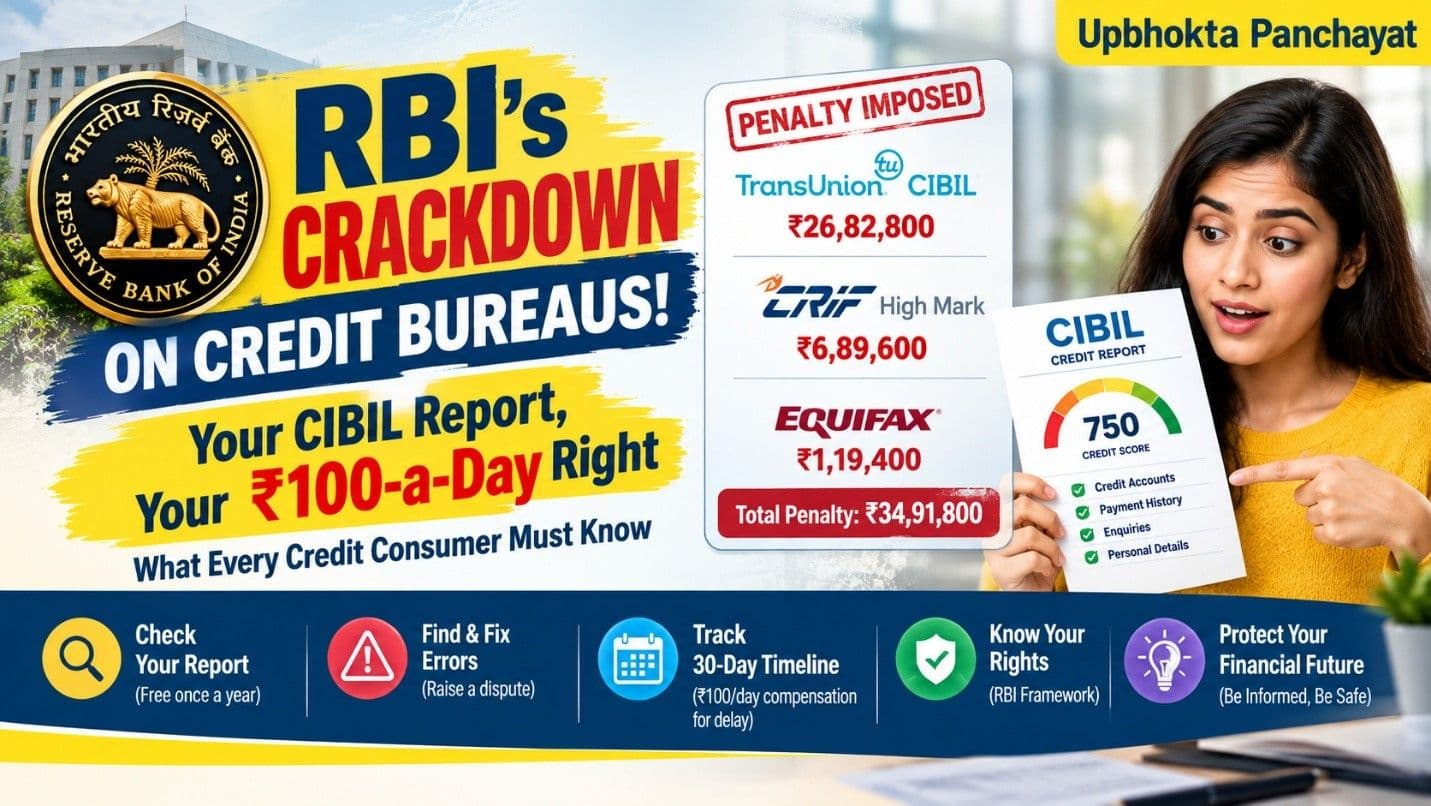
RBI penalises TransUnion CIBIL, CRIF High Mark and Equifax; Upbhokta Panchayat explains what the action means for consumers, how CIBIL works, how to get your free credit report, correct errors and claim compensation for delayed resolution
Key Takeaways
RBI’s Message Is Clear: Credit Data Cannot Be Treated as a Minor Administrative Issue
For most consumers, a credit report is something they think about only when applying for a home loan, personal loan, vehicle loan or credit card.
But behind that three-digit credit score lies something much more important: the accuracy of a consumer's financial identity.
An incorrect overdue entry, an account that does not belong to the consumer, a wrongly reported payment, a duplicate loan account or an unresolved dispute can potentially affect a person's access to formal credit.
That is why the RBI's recent action against three major Credit Information Companies deserves attention far beyond the headline amount of the penalties.
According to the supplied RBI orders, the penalties are:
Credit Information Company
Penalty
TransUnion CIBIL Limited
₹26,82,800
CRIF High Mark Credit Information Services
₹6,89,600
Equifax Credit Information Services
₹1,19,400
Total
₹34,91,800
The RBI's action is significant because it reinforces a broader consumer-protection principle:
When financial information affects a consumer's access to credit, accuracy and timely grievance redressal are not optional service features—they are part of responsible financial conduct.
The RBI's official release confirms the ₹26,82,800 penalty on TransUnion CIBIL, while its official material also records the ₹1,19,400 penalty on Equifax.
But First: What Exactly Is CIBIL?
One of the biggest sources of consumer confusion is the use of the words CIBIL, CIBIL Score and Credit Report interchangeably.
They are not the same thing.
CIBIL
TransUnion CIBIL is a Credit Information Company. It receives credit information from lenders and maintains credit records.
CIBIL Score
The CIBIL Score is a three-digit numerical summary of a consumer's credit history, ranging from 300 to 900.
CIBIL Report
The CIBIL Report contains much more information than the score. It can include credit accounts, payment history, enquiries and personal information associated with the credit profile.
Therefore:
Score = numerical summary
Report = detailed credit history
A consumer should never judge the health of their credit profile by looking at the score alone.
Why Does Your CIBIL Report Matter?
A credit report can become important whenever a lender evaluates a consumer's creditworthiness.
It may be considered when a person applies for:
A good credit history does not guarantee loan approval or a particular interest rate. Lending decisions depend on several factors, including the lender's own credit policy, income, existing liabilities, repayment capacity and other information.
But accurate credit information is fundamental to a fair credit assessment.
This is precisely why an error in a credit report should not be ignored.
How Does a Credit Score Get Damaged?
Consumers often believe that their score falls only because of one missed EMI.
The reality is broader.
1. Late or Missed Payments
Payment history is an important component of a credit profile.
Missing EMI or credit-card payments, particularly when they are reported by the lender, can negatively affect creditworthiness.
Consumer action: Set reminders or use appropriate auto-payment arrangements so that payments are made on time.
2. High Credit Utilisation
Using a very high proportion of available credit can signal greater dependence on revolving credit.
For example, repeatedly using most of a credit card's available limit may not be viewed favourably by lenders.
There is no universal RBI rule saying that every consumer must keep utilisation below exactly 30%, but maintaining reasonable utilisation is a commonly recommended credit-management practice.
3. Multiple Credit Applications
Every application for credit can generate a credit enquiry.
A large number of enquiries over a short period may warrant attention and can influence a credit profile.
Consumer action: Avoid applying for multiple loans or cards indiscriminately.
4. Incorrect Information
This is where consumers need to be especially careful.
Your report may contain:
CIBIL itself advises consumers to check for such inaccuracies and provides an online dispute mechanism.
5. “Settled” or Other Adverse Account Statuses
Consumers sometimes negotiate a settlement with a lender when they are unable to repay the full amount.
Such an account status can influence how lenders assess future applications.
Consumers should therefore understand the consequences before entering into a settlement arrangement and should not confuse “settled” with “paid in full/closed”.
The Most Important Consumer Question: What If My CIBIL Report Is Wrong?
This is where the RBI framework becomes particularly important.
Suppose you find a loan that you never took.
Or perhaps:
Do not simply call customer care and forget about it.
Raise a formal dispute and preserve the evidence.
Step-by-Step: How to Correct an Incorrect CIBIL Report
Step 1 — Download and examine your latest report
Check every account, not just the score.
Step 2 — Identify the exact error
Record:
Step 3 — Raise a formal dispute
CIBIL allows consumers to raise disputes online for inaccuracies in their reports.
Step 4 — Keep the dispute/reference number
This is extremely important.
Keep:
Step 5 — Inform the lender where necessary
CIBIL cannot simply rewrite information supplied by a lender. CIBIL states that changes to reported information require confirmation from the concerned Credit Institution.
This means that consumers should understand an important distinction:
The credit bureau maintains the credit information, but the underlying lender may be responsible for providing or correcting the data.
The 30-Day Rule: Where Does the ₹100-a-Day Right Come From?
This is arguably the most important part of the entire story.
The RBI introduced a framework in October 2023 for compensation relating to delayed updation or rectification of credit information.
Under the framework, if the complaint is not resolved within 30 calendar days from the initial filing, the complainant is entitled to compensation of ₹100 per calendar day of delay, according to the applicable rules.
CIBIL's own published framework explains that Credit Institutions have 21 calendar days and CICs have 9 calendar days, making a total resolution period of 30 calendar days. It also explains that the compensation obligation can fall on the bank/financial institution and/or CIBIL, as applicable.
In simple terms:
Complaint filed
↓
30-calendar-day resolution framework
↓
If the complaint exceeds the permitted period
↓
₹100 per calendar day compensation
↓
Responsibility depends on where the delay occurred
This is much more important than simply saying “CIBIL has 30 days.”
The framework recognises that both the Credit Institution and the CIC can have responsibilities in the dispute-resolution chain.
Is the ₹100 Compensation Automatic?
Consumers should not assume that merely seeing an error automatically guarantees compensation.
The RBI framework concerns delayed updation/rectification of credit information, and eligibility depends on the applicable regulatory conditions and the circumstances of the complaint.
CIBIL states that compensation applies where the dispute exceeds the stipulated 30-day period and that the responsible entity may be the bank/financial institution and/or CIBIL, as applicable.
Therefore, consumers should maintain proper records from the moment they file a dispute.
The complaint date matters.
How Much Can the Compensation Be?
The rate is:
₹100 per calendar day of delay
For example, if a qualifying dispute remains unresolved beyond the prescribed 30-day period and the applicable delay is 10 days, the compensation attributable under the framework would be ₹1,000.
The actual responsibility and calculation should be determined under the applicable RBI framework based on the facts of the case.
What Does the Recent RBI Action Mean for Consumers?
The real significance of the RBI's action is not simply the ₹34.91 lakh total penalty.
The larger message is about accountability.
Credit information companies occupy a critical position in India's financial ecosystem.
Consumers depend on accurate credit information.
Lenders depend on that information to assess borrowers.
And the financial system depends on reliable data.
If a consumer's complaint is delayed, the impact can extend beyond inconvenience.
It may affect:
Therefore, grievance redressal is not merely a customer-service issue.
It is a financial consumer-protection issue.
Free CIBIL Report: Where Can Consumers Get It?
Consumers do not necessarily have to pay for their first CIBIL report of the year.
CIBIL states that consumers can obtain one CIBIL Score and Report free of charge once every calendar year.
The free report can be accessed through the official CIBIL website.
The report includes the CIBIL score and information about the consumer's credit history.
Important consumer advice
Do not rely blindly on third-party apps or advertisements claiming to “repair” your CIBIL score.
For dispute correction, consumers can use the official dispute mechanism.
CIBIL explicitly states that consumers do not need to pay a fee for rectifying discrepancies or updating their credit information.
Should Consumers Check Only CIBIL?
No.
India's credit information ecosystem includes multiple Credit Information Companies.
For consumers whose credit history is available with them, RBI's framework provides access to a Free Full Credit Report once a calendar year from each CIC.
This means a financially aware consumer should consider checking reports from the relevant credit information companies rather than assuming that one report necessarily tells the complete story.
Differences can arise because lenders may report information to different CICs at different times.
What Should You Look for in Your Credit Report?
Upbhokta Panchayat recommends a simple 10-point Credit Report Audit:
1. Personal Details
Check your name, date of birth and other identifying information.
2. Loan Accounts
Make sure every loan actually belongs to you.
3. Credit Cards
Check all cards and their reported status.
4. Payment History
Look for incorrectly reported late or missed payments.
5. Outstanding Balance
Check whether the amount shown matches your records.
6. Account Status
Check whether closed accounts are correctly reflected.
7. Duplicate Accounts
Make sure the same loan has not been reported twice.
8. Credit Enquiries
Look for enquiries that you do not recognise.
9. Fraud/Identity Theft
Immediately investigate any unfamiliar account.
10. Disputed Information
Check whether previously raised disputes have actually been resolved.
What If There Is a Loan in Your Name That You Never Took?
This should be treated seriously.
An unfamiliar loan account may indicate:
The consumer should immediately contact the concerned lender and credit bureau, document the complaint and follow the appropriate fraud-reporting process.
Do not wait until the day you need a loan.
A suspicious account found today is easier to investigate than an unexplained default discovered during an urgent loan application.
Can CIBIL Directly Delete a Wrong Loan?
Not simply on its own.
CIBIL explains that it cannot independently modify or delete information reported by a Credit Institution without confirmation from the relevant institution.
This is an important point because consumers sometimes believe:
“I have complained to CIBIL, so CIBIL will simply delete the account.”
The actual process involves verification and communication with the concerned Credit Institution.
That is why consumers should raise the dispute with the bureau and, where appropriate, the reporting lender.
How to Improve Your CIBIL Score Responsibly
There is no legitimate shortcut to a healthy credit profile.
Pay on time
Never intentionally delay EMI or credit-card payments.
Keep borrowing manageable
Do not take loans simply to increase your credit score.
Avoid unnecessary applications
Multiple applications within a short period should be avoided.
Monitor your report
Regular monitoring helps identify mistakes and possible fraud early. CIBIL itself recommends regular checking of credit information.
Correct errors
Do not accept an incorrect entry simply because “the score will recover eventually.”
First correct the underlying data.
Be cautious about “credit repair” promises
Nobody can legitimately guarantee an instant score improvement by deleting accurate negative information.
One Important Myth: Paying Someone to “Fix CIBIL”
Consumers should be extremely cautious about advertisements such as:
“CIBIL 800+ guaranteed.”
“Remove all negative entries.”
“Loan approval guaranteed.”
“CIBIL repair in 48 hours.”
A legitimate correction requires the underlying information to be verified and, where applicable, corrected by the reporting Credit Institution.
CIBIL itself states that consumers do not need to pay a fee for correcting discrepancies or updating credit information.
What Should a Consumer Do If the Complaint Is Not Resolved?
Use a documented escalation approach.
Step 1
Raise the dispute with the relevant Credit Information Company.
Step 2
Raise the issue with the concerned bank/NBFC/Credit Institution where applicable.
Step 3
Preserve the complaint/reference number and date.
Step 4
Track the 30-calendar-day regulatory timeline.
Step 5
If the applicable compensation is not provided or the grievance remains unresolved, escalate through the appropriate RBI grievance mechanism, including the RBI Complaint Management System (CMS) where applicable.
Consumers should first follow the regulated entity's complaint process and then use the RBI's escalation mechanism when the conditions for doing so are met.
A Simple Consumer Timeline
Day 0
Complaint / dispute filed
↓
Credit Institution + CIC process the dispute
↓
30 calendar days
↓
If resolved within the prescribed period
Dispute closed
If delayed beyond the prescribed period
₹100 per calendar day compensation may become applicable under the RBI framework
↓
If compensation/grievance remains unresolved
↓
Escalate through the appropriate grievance mechanism, including RBI CMS where applicable
What Consumers Should Save as Evidence
Every credit dispute should be treated like a documented consumer case.
Maintain a folder containing:
This evidence can become extremely important if the matter needs escalation.
Upbhokta Panchayat Research & Consumer Perspective
The latest RBI action should not be viewed only through the lens of the monetary penalties imposed on three companies.
Its larger significance lies in the consumer accountability principle.
India's financial system is becoming increasingly data-driven. Credit information influences access to formal finance, while digital lending, credit cards, consumer finance and financial applications continue to expand.
In such an environment, a consumer must have three basic protections:
Accurate Data
Information used to assess consumers should be complete and correct.
Accessible Redress
Consumers should have a clear and usable mechanism to challenge incorrect information.
Accountability for Delay
Where the regulatory framework provides compensation for delayed resolution, consumers should receive it as prescribed.
This is the real consumer-protection lesson emerging from the RBI's action.
The Upbhokta Panchayat Consumer Checklist
Before applying for your next major loan, ask yourself:
✓ Have I checked my latest credit report?
✓ Do I recognise every loan and credit card?
✓ Are all my payments correctly reported?
✓ Are closed accounts correctly shown?
✓ Are there any unfamiliar enquiries?
✓ Is there any fraudulent account?
✓ Have I disputed every genuine error?
✓ Did I save my dispute reference number?
✓ Have I tracked the 30-day timeline?
✓ If there was qualifying delay, have I checked my compensation entitlement?
Bottom Line: Your Credit Report Is Your Financial Identity
A credit score may appear to be just a three-digit number.
It is not.
Behind that number is a detailed record of how your credit history is reported to the financial system.
That is why consumers should not wait until a loan application is rejected to discover that their credit report contains an error.
The RBI's latest action against three Credit Information Companies sends a strong regulatory signal: consumer grievance redressal and compensation obligations must be taken seriously.
For consumers, the message is equally clear:
Check your credit report. Challenge errors. Keep evidence. Track the timeline. Know your compensation rights.
And perhaps the most important lesson is this:
Do not treat your CIBIL report as something only banks need to see. It is your financial record—and you have the right to question information that is wrong.
Official Consumer Resources
RBI: Regulatory framework on delayed updation/rectification of credit information and compensation.
CIBIL: Free CIBIL Score & Report, dispute process and consumer guidance.
CIBIL Compensation Framework: 30-day resolution framework and ₹100-per-calendar-day compensation.
RBI Complaint Management System: Consumers can use RBI's official grievance mechanism where applicable after following the prescribed complaint process.
Consumer Guidance: Consumers should use official channels and should not pay unauthorised agents promising instant CIBIL correction.
Sources: RBI and TransUnion CIBIL; independently written and edited by Upbhokta Panchayat.