LOADING...
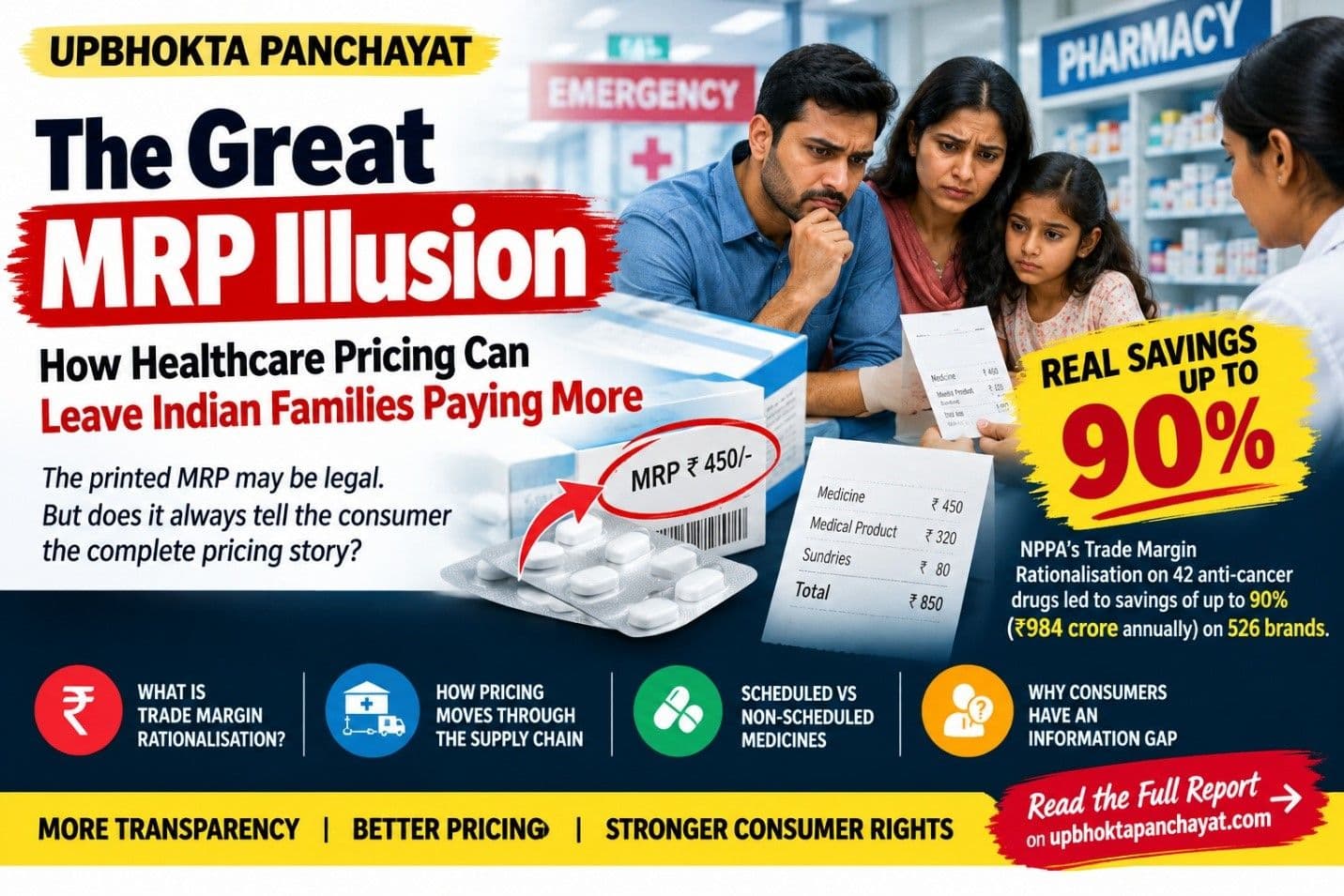
The printed MRP may be legal. But does it always tell the consumer the complete pricing story?
Imagine This
A family is sitting outside a hospital emergency room.
A doctor has prescribed medicines and several medical products. There is no time to visit five pharmacies, compare ten brands or investigate the supply chain.
The family goes to the pharmacy.
The bill arrives.
One question is asked:
“Why is this so expensive?”
The answer is immediate:
“Sir, we are charging only the MRP.”
That may answer one legal question.
But it leaves another—and potentially much bigger—consumer question unanswered:
Who decided that MRP?
This is the beginning of India's largely invisible healthcare pricing debate.
MRP Is a Maximum Price—But It Is Not Necessarily a Measure of Value
For a consumer, MRP appears deceptively simple.
A product has a printed price.
The seller should not ordinarily charge more than the applicable MRP.
But the printed MRP does not, by itself, tell the consumer:
And this distinction becomes particularly important in healthcare.
Because a consumer buying a television can postpone the purchase.
A patient cannot always postpone treatment.
THE OFFICIAL EVIDENCE: A 90% REDUCTION IS NOT A RUMOUR
There is one number that deserves serious attention.
90%
According to the National Pharmaceutical Pricing Authority (NPPA), its Trade Margin Rationalisation intervention covering 42 selected anti-cancer drugs resulted in savings of up to 90%, amounting to approximately ₹984 crore per annum, in the case of 526 brands.
526 BRANDS
UP TO 90% SAVINGS
₹984 CRORE REPORTED ANNUAL SAVINGS
This is not an estimate prepared by Upbhokta Panchayat.
It is information reported by India's pharmaceutical price regulator.
And it raises an important consumer-policy question:
If regulatory intervention can produce such substantial savings in a defined category, how much more transparency should consumers receive about healthcare pricing across other categories?
What Exactly Is Trade Margin Rationalisation?
Trade Margin Rationalisation, or TMR, is an approach through which the government can regulate trade margins in specified categories.
The significance is simple:
The price paid by a patient is not created at only one point in the supply chain.
It can reflect several layers of commercial activity.
Manufacturer
↓
Distributor / Stockist
↓
Retailer / Pharmacy / Institutional Supply
↓
Patient
The consumer generally sees only the final number.
THE HEALTHCARE PRICING INFORMATION GAP
In ordinary retail markets, consumers can compare.
They can:
Healthcare is different.
During illness or an emergency, the consumer's bargaining power can become extremely limited.
This creates a classic information asymmetry.
The seller may know:
What the product costs.
The consumer may know only:
What the product costs them.
That difference matters.
SCHEDULED VS NON-SCHEDULED MEDICINES: WHY THE DIFFERENCE MATTERS
India's drug-price regulation does not treat every medicine in exactly the same way.
Under DPCO 2013, medicines included in the applicable Schedule are subject to price control. NPPA states that the ceiling price for scheduled formulations is derived using market-based data and includes a 16% margin on the average Price to Retailer (PTR); applicable local taxes are then added to arrive at the MRP.
As of 23 June 2026, NPPA reported that ceiling prices had been fixed for 935 formulations, covering areas including diabetes, cancer, cardiovascular diseases, analgesics and antipyretics, and tuberculosis.
This provides consumers with an important protection:
A regulated ceiling-price framework exists for scheduled formulations.
But the healthcare market also contains non-scheduled medicines and medical devices where the pricing framework can be different.
That is why simply saying:
“Medicine prices are controlled.”
does not tell the whole story.
THE NON-SCHEDULED MARKET NEEDS GREATER CONSUMER UNDERSTANDING
NPPA states that for non-scheduled formulations, companies have greater freedom to decide trade margins, while NPPA monitors prices and can take corrective measures where warranted.
This creates a crucial distinction:
Price flexibility does not automatically mean unfair pricing.
But neither does:
“It is within MRP” automatically mean “it is the best available value for the consumer.”
The two questions are different.
THE MEDICAL DEVICE QUESTION
The same issue extends beyond medicines.
During the COVID-19 period, NPPA capped the trade margin at 70% at the Price to Distributor (PTD) level for Oxygen Concentrators and five other medical devices:
NPPA says these measures were introduced through notifications dated 3 June 2021 and 13 July 2021.
Again, the lesson is not that every medical device has an excessive margin.
The lesson is that:
The government has already demonstrated that trade-margin intervention can be used as a policy tool where affordability becomes a serious concern.
THE DISCOUNT TRAP
Now consider another familiar situation.
A product has an MRP of:
₹1,000
The consumer is offered:
20% DISCOUNT
The bill becomes:
₹800
The consumer sees a saving of ₹200.
But there is another question:
₹1,000 compared with what?
A discount from MRP does not, by itself, establish that the final price represents good value.
The consumer still needs information about:
A discount is not the same thing as transparency.
WHAT CONSUMERS SHOULD ASK
Before accepting healthcare pricing at face value, consumers should ask four simple questions.
1. WHAT IS IT?
Is the product:
The regulatory framework may differ.
2. WHAT IS THE APPLICABLE PRICE?
Check:
For medicines covered by NPPA's pricing framework, consumers can use official price-verification resources.
NPPA's Pharma Sahi Daam is specifically designed to allow consumers to check prices of scheduled and non-scheduled medicines and identify possible overpricing.
3. IS THERE AN ALTERNATIVE?
Where medically appropriate, consumers can ask whether a generic or equivalent product is available.
The decision about clinical suitability must remain with the treating medical professional.
4. CAN I GET AN ITEMISED BILL?
A detailed bill should identify what was actually supplied.
Consumers should retain:
These documents become important if a pricing dispute arises.
UPBHOKTA PANCHAYAT'S MRP TRANSPARENCY TEST
Upbhokta Panchayat proposes a simple four-step approach for healthcare consumers:
PRICE → PRODUCT → REGULATION → ALTERNATIVE
PRICE
What exactly am I being charged?
PRODUCT
What exactly am I purchasing?
REGULATION
Is this product covered by a ceiling price or trade-margin regulation?
ALTERNATIVE
Is there a clinically appropriate alternative that the consumer can consider?
This approach moves the consumer beyond the narrow question:
“Is the bill below MRP?”
towards the more meaningful question:
“Do I have enough information to make an informed choice?”
WHAT UPBHOKTA PANCHAYAT RECOMMENDS
Upbhokta Panchayat believes India's healthcare consumer-protection framework should move towards greater price transparency and comparability.
1. HEALTHCARE PRICE TRANSPARENCY
Consumers should have simple access to authoritative information about applicable pricing rules for medicines and healthcare products.
2. CLEARER HOSPITAL BILLS
Hospital bills should clearly identify the product or service supplied, quantity, applicable MRP and billed amount wherever relevant.
3. BETTER PRODUCT CLASSIFICATION
Consumers should be able to easily understand whether an item is a medicine, medical device, consumable or service.
4. STRONGER MONITORING OF HIGH-VARIATION CATEGORIES
Where substantial price variation exists between comparable products, regulators should have access to reliable market data for examination.
5. CONSUMER-FRIENDLY PRICE VERIFICATION
Government price-verification mechanisms should be made more visible and easier for ordinary consumers to use.
6. GREATER GENERIC AWARENESS
Consumers should be educated about generic names and clinically appropriate alternatives without compromising the doctor's responsibility for treatment decisions.
WHAT CAN CONSUMERS DO TODAY?
CHECK THE PRICE
Use official NPPA information where applicable.
ASK FOR AN ITEMISED BILL
Do not hesitate to request clarity about individual products and charges.
CHECK THE LABEL
Look at the:
COMPARE WHEN TIME PERMITS
In non-emergency situations, compare legitimate pharmacies and available alternatives.
KEEP THE DOCUMENTS
Bills, prescriptions and packaging can become important evidence in a complaint.
RAISE A GRIEVANCE WHEN APPROPRIATE
The Government's National Consumer Helpline (NCH) accepts consumer grievances through 1915, its online portal, WhatsApp and other channels.
NCH is a pre-litigation grievance mechanism; consumers who remain dissatisfied can approach the appropriate Consumer Commission.
For medicine-price related complaints, NPPA also provides the Pharma Sahi Daam mechanism and lists a dedicated complaint process.
THE BIGGER QUESTION
Healthcare is not an ordinary marketplace.
The consumer is often making decisions under pressure, uncertainty and time constraints.
That makes information even more important.
The issue is therefore not simply:
“Was the consumer charged above MRP?”
That remains an important legal and consumer-protection question.
But there is another question that deserves equal attention:
“Was the consumer given enough information to understand the price?”
The official record already demonstrates that pricing interventions can have a substantial effect.
In the selected anti-cancer medicine intervention, NPPA reported savings of up to 90%, amounting to approximately ₹984 crore per annum, in the case of 526 brands.
That experience provides an important lesson for policymakers:
Transparency and affordability cannot be treated as separate consumer issues.
THE UPBHOKTA PANCHAYAT VIEW
A fair healthcare marketplace should give consumers:
Clear information.
Meaningful choice.
Transparent bills.
Effective regulation.
Accessible grievance mechanisms.
And above all:
The ability to understand what they are paying for.
MRP should remain an important consumer-protection tool.
But the consumer conversation should not end at the printed number.
Because the real question is not only whether the price is legal.
The real question is whether the healthcare consumer has enough information to make an informed choice.
Editorial Note & Sources
The figures relating to 526 brands, savings of up to 90% and approximately ₹984 crore per annum are based on information published by the National Pharmaceutical Pricing Authority (NPPA), Government of India.
Information relating to scheduled formulations, ceiling-price methodology, the 16% PTR margin and 935 formulations is based on NPPA's official proactive-disclosure information.
Information regarding non-scheduled formulations and applicable monitoring is based on NPPA's official FAQs.
Information regarding consumer grievance mechanisms is based on the official National Consumer Helpline, Department of Consumer Affairs.
This article is intended for consumer education and policy discussion. Pricing treatment depends on the classification, regulatory status and applicable legal provisions governing the particular medicine, medical device or healthcare product.