LOADING...
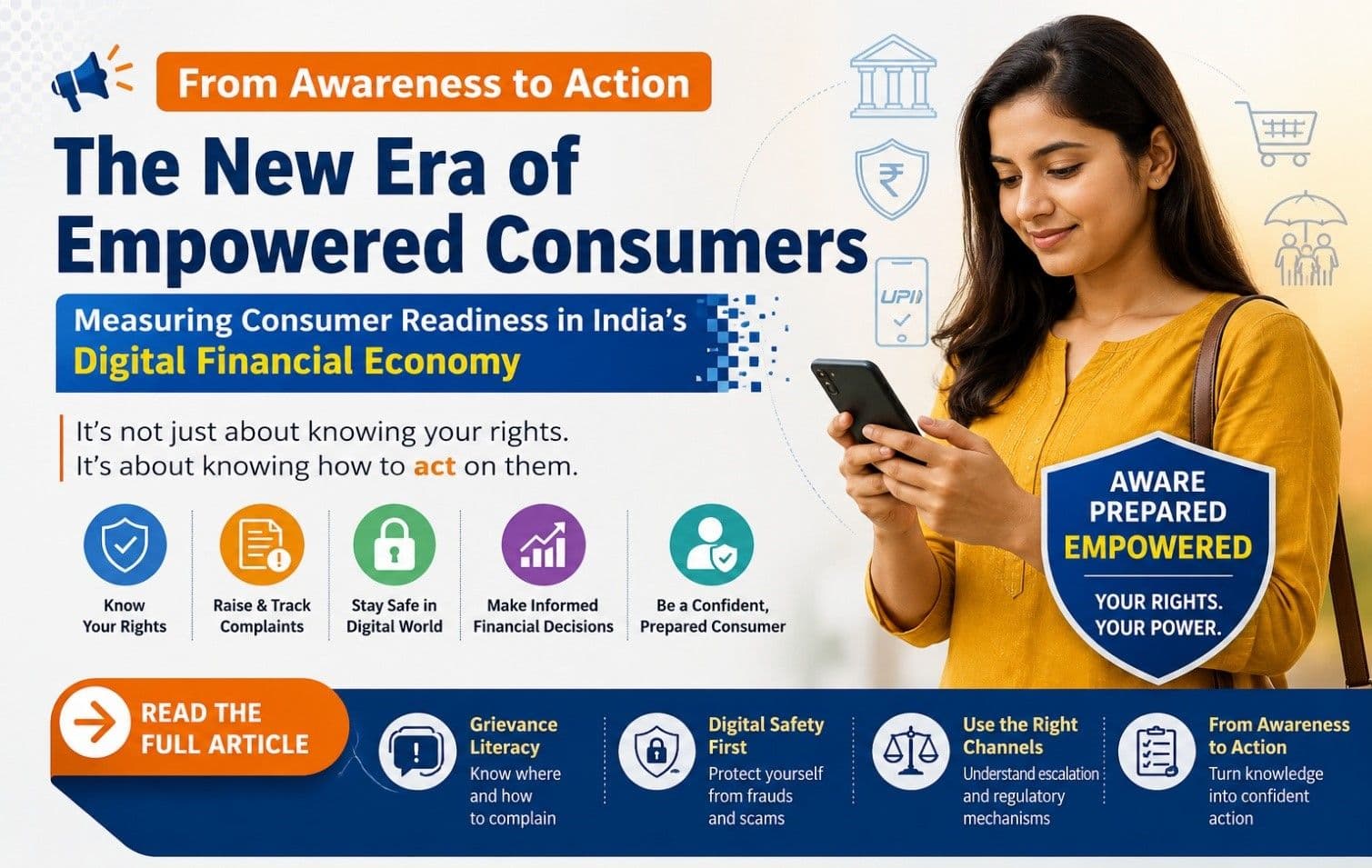
Why Financial Literacy Must Now Include Grievance Literacy, Digital Safety and the Ability to Act
India’s financial and consumer landscape has undergone a fundamental transformation over the past decade. Banking, insurance, investments, digital payments, e-commerce and other consumer services have moved rapidly towards digital delivery. A consumer can now open a bank account, obtain a loan, purchase an insurance policy, invest, make a payment or raise a grievance without entering a physical branch.
This transformation has brought enormous convenience and has significantly expanded access.
But access is not the same as empowerment.
The important question for the next phase of consumer protection is therefore not simply whether consumers have access to financial services or whether information is available online.
The more important question is:
Can consumers understand the information, recognise the risks, exercise their rights and take the correct action when something goes wrong?
This distinction is becoming increasingly important.
A consumer may know how to make a UPI payment but may not know what to do after an unauthorised transaction.
A borrower may understand the amount of an EMI but not necessarily understand all associated charges.
An insurance customer may purchase a policy digitally but discover only at the time of a claim that important conditions were misunderstood.
An investor may have access to hundreds of financial products but still be unable to distinguish a regulated investment opportunity from a fraudulent promise.
And a consumer may know that a grievance mechanism exists but remain uncertain about where to complain, when to escalate, what documents to preserve and which authority is actually responsible.
This is the emerging consumer awareness–action gap.
The Consumer Awareness–Action Gap
Traditional financial literacy programmes have generally focused on helping people understand financial concepts.
Saving.
Borrowing.
Insurance.
Investments.
Interest rates.
Digital payments.
Budgeting.
These remain essential.
But the modern financial consumer requires another layer of knowledge.
A consumer must also know how to act.
The difference can be expressed simply:
Awareness answers: “What do I know?”
Consumer readiness answers: “What can I do with what I know?”
A consumer who understands that unauthorised transactions should be reported promptly is better prepared than a consumer who simply knows that cyber fraud exists.
A consumer who knows the appropriate grievance channel and understands the escalation process is more empowered than one who merely knows that a regulator has a complaint mechanism.
A consumer who knows how to verify an investment intermediary before transferring money is better protected than one who has simply attended a financial literacy lecture.
Consumer education must therefore evolve from information delivery to action-oriented learning.
India’s Grievance Architecture Is Becoming More Accessible
The regulatory ecosystem has also evolved.
The Reserve Bank – Integrated Ombudsman Scheme, 2026 came into force on July 1, 2026 and replaced the earlier 2021 scheme. The framework provides a structured alternate grievance-redress mechanism for eligible complaints involving deficiency in service by covered regulated entities. It also provides for a centralised complaint mechanism, tracking and other processes intended to make grievance redress more accessible.
These developments represent an important institutional strengthening of consumer protection.
But a grievance mechanism can be effective only when consumers can navigate it.
That creates an important distinction between:
availability of a mechanism
and
ability to use the mechanism.
The first is an institutional question.
The second is a consumer-education question.
The Missing Link: Grievance Literacy
Financial literacy should now be understood more broadly.
Alongside financial knowledge, consumers need grievance literacy.
Grievance literacy means the practical ability to understand:
This is not merely procedural knowledge.
It is an important component of consumer protection.
The Reserve Bank of India has consistently emphasised consumer awareness regarding grievance-redress mechanisms and the avenues available to customers when their complaints remain unresolved.
The policy direction is therefore clear:
A consumer-protection system requires both an effective mechanism and an informed consumer.
The Last Mile Is the Real Test
India has developed sophisticated digital systems, but the consumer does not experience the financial system as a collection of regulations and institutions.
The consumer experiences a problem.
“My money has not been credited.”
“My insurance claim has been delayed.”
“My account has been charged.”
“My card transaction was unauthorised.”
“My loan charges were different from what I understood.”
“My investment adviser is not responding.”
“My complaint has not been resolved.”
For the consumer, the institutional boundaries between a bank, NBFC, payment system, regulator, ombudsman, consumer authority or cybercrime mechanism may not always be obvious.
This is where consumer navigation becomes critical.
A consumer who is directed to the correct official mechanism at the right time has a substantially better chance of taking appropriate action.
A consumer who reaches an incorrect or unofficial channel may lose time, money and sometimes critical evidence.
The Importance of Trusted Consumer Navigation
This is one reason why easily accessible grievance information can play a significant role in consumer empowerment.
Upbhokta Panchayat’s India Complaint Directory currently provides 98 verified complaint and grievance portal links covering areas including banking and finance, consumer affairs, cybercrime, taxation, transport, healthcare, education and other public services. The platform clearly states that it is an independent consumer-awareness resource and that complaints should be filed through the official authorities listed in the directory.
This distinction is important.
Consumer organisations should not replace regulators or official grievance systems.
They should help consumers reach them.
The role is therefore not:
“We will solve your complaint.”
It is:
“We will help you understand where and how to take your complaint through the appropriate official channel.”
That approach can reduce consumer dependence on unverified intermediaries while strengthening awareness of formal grievance mechanisms.
Digital Financial Literacy Is No Longer Enough
Digital financial literacy must also evolve.
Earlier, digital literacy could largely mean understanding how to use online banking, mobile applications and digital payment systems.
Today, the consumer needs a much wider set of capabilities.
A digitally aware consumer should know:
How to verify a link before clicking.
How to recognise impersonation.
Why OTPs, PINs and passwords must remain confidential.
How to identify suspicious investment promises.
Why an unsolicited “customer-care” number may not be genuine.
What immediate steps should be taken after a fraudulent transaction.
Where an incident should be reported.
How to preserve evidence such as transaction records, messages and screenshots.
This makes cyber-fraud awareness an integral part of consumer protection.
Financial inclusion without adequate digital safety can create new forms of vulnerability.
The objective of financial education should therefore be to create consumers who are not only able to use digital financial services, but are also able to recognise risks and respond appropriately.
Financial literacy without digital safety is incomplete.
The Consumer Journey Matters
Consumer protection can also be viewed as a journey rather than a single event.
A typical financial consumer journey may look like:
Information → Choice → Transaction → Problem → Complaint → Response → Escalation → Resolution → Trust
Every stage presents a potential consumer-protection challenge.
At the information stage, the consumer may receive incomplete or difficult-to-understand information.
At the choice stage, the consumer may not understand product suitability.
At the transaction stage, the consumer may overlook terms and charges.
At the problem stage, the consumer may not know what evidence to preserve.
At the complaint stage, the consumer may approach the wrong channel.
At the escalation stage, the consumer may not understand the applicable process.
At the resolution stage, the consumer may not understand the response.
And after resolution, the consumer may either regain confidence—or lose trust in the system.
This suggests that consumer protection should not be assessed only at the point of complaint.
It should be considered across the entire consumer journey.
From Complaint Disposal to Consumer Outcome
One of the important distinctions in modern consumer protection is the difference between disposal and outcome.
A complaint can be closed administratively.
But has the consumer actually understood the outcome?
Was the problem addressed?
Was the consumer informed clearly?
Did the consumer receive the appropriate remedy, where applicable?
Did the consumer understand why the complaint was accepted, rejected or otherwise dealt with?
Did the consumer know what options remained available?
These questions do not diminish the importance of complaint-disposal data.
Instead, they add another dimension.
What was the consumer’s experience of the process?
A strong grievance-redress mechanism should therefore be evaluated not only by the number of complaints received or disposed of, but also by the extent to which consumers can understand and navigate the process.
This is particularly important as grievance systems become increasingly digital.
Why Consumer Workshops Still Matter
In an increasingly digital economy, it may appear that websites, apps and online videos can provide all necessary consumer education.
They cannot do everything.
A workshop creates interaction.
A senior citizen can ask how to identify a fraudulent banking call.
A student can ask how an investment scam works.
A woman can ask how to understand an insurance policy.
A borrower can explain a difficulty with a lender.
A first-time digital user can ask what to do after an unauthorised transaction.
These questions are valuable because they reveal the difference between what information providers believe consumers need and what consumers actually struggle to understand.
Workshops therefore serve two functions:
Education and feedback.
They translate general information into real-life situations.
They also expose gaps in consumer understanding that may not be visible through conventional digital communication.
Who Needs Consumer Education the Most?
Consumer education should not be treated as a uniform exercise.
Different groups face different risks.
Young Consumers
Young people are becoming financial consumers earlier.
They need awareness of digital payments, credit, online shopping, investment scams, social-media fraud and responsible borrowing.
Senior Citizens
Senior citizens may require greater assistance in navigating digital banking, insurance, investments and fraud prevention.
Simple language and human interaction can be particularly valuable.
Women Consumers
Financial inclusion becomes more meaningful when access is accompanied by confidence and knowledge.
Women need practical awareness of banking, insurance, investments, digital transactions, fraud prevention and grievance mechanisms.
Rural and Semi-Urban Consumers
The challenge may not simply be lack of information.
It may be the accessibility, language, format and credibility of that information.
Consumer education therefore needs to reach people beyond metropolitan centres.
Language Is a Consumer-Protection Tool
India’s linguistic diversity makes language an important part of consumer protection.
A consumer may technically have access to information but still not fully understand it if it is presented in unfamiliar or excessively technical language.
This is particularly relevant for financial products, contracts, insurance conditions, digital-security warnings and grievance procedures.
Hindi and other Indian languages can therefore play a significant role in expanding consumer awareness.
The availability of consumer-support mechanisms in multiple Indian languages also demonstrates the importance of language accessibility in grievance support.
Consumer education should follow the same principle.
Simple language is not a reduction in sophistication. It is an increase in accessibility.
The Role of Independent Consumer Platforms
Regulators establish rules and institutional mechanisms.
Financial institutions provide services.
Government systems provide public infrastructure.
Independent consumer platforms can play a complementary role by translating complex information into consumer-friendly language and connecting citizens with legitimate institutional mechanisms.
This is where digital consumer-awareness platforms have an important role.
Upbhokta Panchayat is positioned as a consumer education, research and public-awareness initiative with a legacy of more than 20 years. Its platform brings together consumer news, educational resources, research reports, comparative studies, expert interviews and grievance-navigation information. Its stated mission includes consumer education, financial and digital literacy, evidence-based policy dialogue and collaboration with regulators, government institutions, academic institutions and civil society.
The value of such a platform is not that it replaces official institutions.
Its value lies in helping consumers understand them.
Consumer Education Should Become Continuous
One-off awareness campaigns can create temporary attention.
Continuous education can create stronger consumer capability.
A consumer may attend one workshop on cyber fraud.
But fraud techniques evolve.
A consumer may learn how to use UPI.
But new payment features and risks emerge.
A consumer may learn about insurance.
But new products and distribution channels appear.
A consumer may learn how to complain.
But grievance systems can change.
Consumer education must therefore become continuous rather than occasional.
This requires a combination of:
Digital content
Workshops
Videos
Regional-language communication
Practical examples
Grievance-navigation tools
Consumer feedback
Updated educational material
The objective should be to create an ecosystem in which consumers can return to trusted information whenever they face a new situation.
The Consumer Readiness Framework
The emerging approach can be understood through six dimensions of consumer readiness:
Dimension
Core Question
Financial Awareness
Does the consumer understand the product and its basic risks?
Digital Safety
Can the consumer identify and avoid common digital threats?
Rights Awareness
Does the consumer know the relevant rights and protections?
Grievance Literacy
Does the consumer know where and how to complain?
Process Understanding
Does the consumer understand escalation and follow-up?
Action Readiness
Can the consumer take the appropriate next step?
This framework does not suggest that every consumer must become a financial expert.
The objective is much simpler.
Consumers should have enough practical knowledge to make safer decisions and respond appropriately when problems arise.
From Information to Confidence
The ultimate purpose of consumer education is not information accumulation.
It is confidence.
A consumer should feel confident enough to ask:
What am I buying?
Who is providing it?
What will it cost me?
What are the risks?
What information should I verify?
What should I do if something goes wrong?
Where is the official mechanism for help?
That confidence is a critical component of a healthy financial ecosystem.
It strengthens responsible participation.
It can reduce vulnerability to fraud.
It can improve the quality of consumer decisions.
And it can help consumers use formal grievance mechanisms instead of relying on unverified intermediaries.
A Stronger Consumer Protection Ecosystem
India has already built significant institutional capacity for consumer protection.
The next challenge is to make that protection more visible, understandable and usable.
The future of consumer protection should therefore be built around three connected pillars:
Regulation
Clear standards, rights and institutional responsibilities.
Redressal
Accessible, credible and effective mechanisms for resolving legitimate grievances.
Readiness
Consumers who understand their choices, recognise risks and know how to act.
The first two cannot achieve their full potential without the third.
A sophisticated grievance mechanism is valuable.
A well-informed consumer who knows how to use it is even more valuable.
From Awareness to Action
The central challenge for India’s consumer movement is no longer simply the availability of information.
Information is everywhere.
The challenge is credible, understandable and actionable information.
The consumer should not discover their rights only after suffering a financial loss.
The consumer should understand the risks before making the transaction.
The consumer should know the appropriate grievance channel before frustration turns into helplessness.
The consumer should know how to respond before a fraud becomes irreversible.
And the consumer should be able to access trusted information in a language and format that they can actually understand.
This is where consumer education acquires a much larger meaning.
It is not merely about conducting awareness programmes.
It is about building consumer capability.
It is not merely about publishing information.
It is about enabling informed action.
It is not merely about increasing financial inclusion.
It is about ensuring that inclusion is accompanied by knowledge, safety, confidence and recourse.
India’s digital financial economy will continue to expand.
The institutions protecting consumers will continue to evolve.
Grievance mechanisms will become increasingly technology-driven.
But the fundamental principle will remain unchanged:
A strong consumer-protection system ultimately depends on an informed consumer who knows what to do next.
The future of consumer protection, therefore, is not simply more information.
It is:
Better information.
Better understanding.
Better preparedness.
Better action.
And ultimately,
A more confident and empowered Indian consumer.
References: Reserve Bank of India (RBI) — Consumer Protection, Financial Awareness & Grievance Redressal Resources