LOADING...
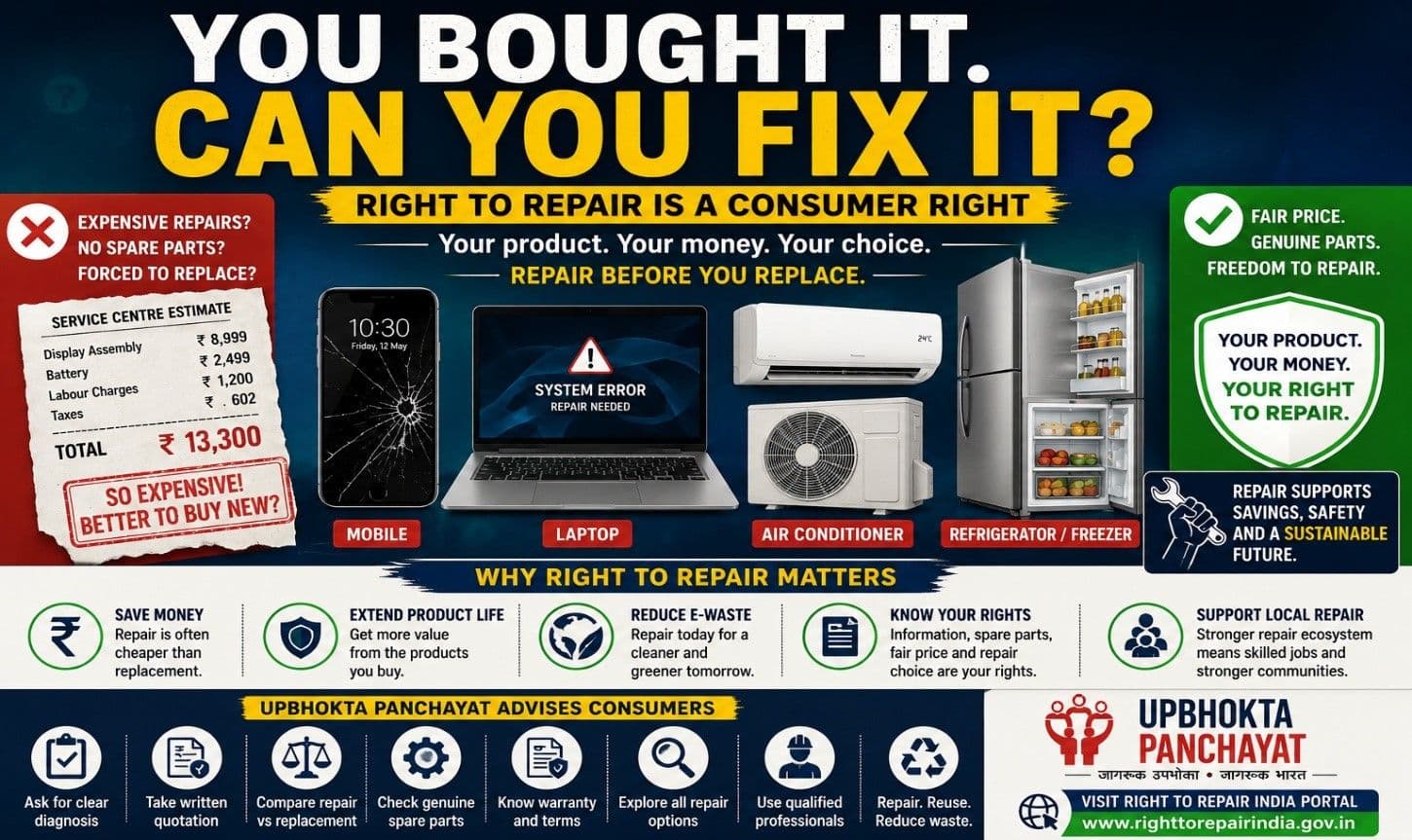
Imagine spending ₹50,000 on a smartphone.
It works perfectly for two years. Then the battery begins to fail.
The screen works. The camera works. The processor works. Your data is intact.
Only the battery needs attention.
You take the phone for repair and receive an estimate that makes you pause. The repair may cost several thousand rupees—or you may be told that an entire component or assembly has to be replaced.
And then comes the familiar thought:
“At this price, I might as well buy a new phone.”
This is where a simple repair problem becomes a much bigger consumer-rights question.
If consumers own the product, shouldn't they have a meaningful choice about how it is repaired?
That is the central idea behind the Right to Repair movement.
India has already taken important steps in this direction. The Government's Right to Repair India initiative provides consumers with information relating to repair, warranties, spare parts and service options for covered products. The framework covers sectors including mobile and electronic devices, consumer durables, automobiles and farming equipment.
But the real test is not whether a portal exists.
The real test is whether an ordinary consumer can actually get a product repaired safely, reasonably quickly and at a reasonable cost.
The Hidden Cost of “Buy Again”
Modern consumers can purchase almost anything with a few clicks.
A smartphone, laptop, washing machine or air conditioner can arrive at the doorstep within days—or even hours.
But what happens after the product develops a fault?
Consumers may suddenly face a completely different set of questions:
These are not minor technical questions.
They determine whether consumers have real choice or merely the appearance of choice.
The Department of Consumer Affairs has identified repair-related concerns as an important consumer issue. Its report on a proposed Repairability Index framework noted that complaints relating to mobile phones and tablets received through the National Consumer Helpline increased from 19,057 in 2022–23 to 22,864 in 2024–25.
The message is clear:
When repair becomes difficult, expensive or uncertain, consumers can be pushed towards replacement.
Right to Repair Is Not the Right to Unsafe Repair
There is an important distinction.
Right to Repair does not mean that every consumer should open a smartphone, dismantle an air conditioner or attempt to repair an electric vehicle battery without the necessary skills.
Modern products can involve electricity, lithium-ion batteries, refrigerants, high-voltage systems and sophisticated electronic components.
An unsafe repair can create a bigger problem than the original fault.
Therefore, a responsible Right to Repair ecosystem should be based on:
Information + Genuine Parts + Qualified Repair + Safety + Transparent Pricing
The objective should not be to eliminate manufacturers' authorised service networks.
The objective should be to give consumers more informed and reasonably accessible repair choices.
Your Smartphone Is More Than a Phone
Smartphones illustrate the issue particularly well.
For millions of consumers, a smartphone is now:
When a smartphone becomes difficult or excessively expensive to repair, consumers may not simply be losing a gadget.
They may be losing access to a significant part of their digital lives.
This makes repairability increasingly relevant to consumer welfare.
The Government's Right to Repair framework includes mobile phones, tablets, laptops, batteries and printers within the mobile and electronics category.
“The Product Is Repairable”—But Can the Consumer Prove It?
One of the biggest problems is not necessarily that products cannot be repaired.
It is that consumers often do not have enough clear and comparable information about repair.
Before purchasing an expensive product, consumers should ideally know:
How repairable is it?
How long will spare parts be available?
What will common repairs cost?
Can the battery or other major components be replaced?
Is repair documentation available to qualified technicians?
What happens to the warranty after a repair?
How long is the expected support period?
Without this information, consumers cannot properly compare products.
A product that appears cheaper at the time of purchase may ultimately cost more if it is difficult or expensive to maintain.
Repairability should therefore become part of the purchase decision—not an issue discovered only after the product breaks.
India’s Repairability Index: A Potential Game Changer
India has begun moving towards making repairability more visible to consumers.
The Department of Consumer Affairs has worked on a Repairability Index framework for smartphones and tablets, with recommendations aimed at making repairability information more accessible at the point of purchase, including through e-commerce platforms and QR-based information.
This could change the way consumers compare products.
Imagine two smartphones being compared not only on:
Price + Camera + Storage + Processor
but also on:
Repairability + Spare-Part Availability + Repair Cost + Support Period
Suddenly, consumers have another important question to ask:
“Which product will cost me less over its entire useful life?”
That is a much more meaningful measure of value.
Repairability Could Become the Next Product Comparison Metric
For years, consumers have compared products based on features.
Screen size.
Camera quality.
Storage.
Mileage.
Energy efficiency.
Warranty.
Price.
The next question should be:
How easy and affordable is this product to repair?
A meaningful repairability assessment could consider factors such as:
The more transparent these factors become, the more consumers can move from thinking about purchase price to thinking about lifetime value.
What About Local Repair Shops?
India has a huge network of local repair professionals.
From neighbourhood mobile technicians to appliance repair specialists, independent repair businesses help keep millions of products in use.
But modern products are becoming increasingly sophisticated.
A skilled technician may still face difficulties because of limited access to:
This creates a strange situation:
The consumer wants the product repaired.
The technician may have the skill to repair it.
But the ecosystem may not provide the information or parts required.
A stronger Right to Repair framework could therefore benefit not only consumers but also India's small repair businesses.
Better access to legitimate parts, technical information and training could help create a more organised repair economy.
Genuine Spare Parts: Consumers Should Not Have to Guess
When genuine spare parts are difficult to obtain, consumers may turn to informal markets.
That can create risks involving:
A consumer should be able to answer a basic question:
“Is this part genuine, compatible and covered by any applicable warranty?”
Transparency about spare parts is therefore an important component of consumer protection.
Consumers should not have to choose between paying an unreasonable amount at one end and risking an unreliable component at the other.
The Warranty Confusion
Warranty is another area where consumers frequently become confused.
A consumer may be told:
“If you get it repaired outside our service network, your warranty will be affected.”
But consumers should not rely solely on verbal statements.
They should examine the applicable warranty terms and ask for clarification in writing.
Before authorising a repair, ask:
What exactly has failed?
Is the repair covered by warranty?
Which component will be replaced?
What is the cost of the component?
What is the labour charge?
What warranty is provided on the repair?
Will the repair affect any remaining warranty?
Is there another authorised repair option?
Never make an expensive repair decision without understanding what you are paying for.
Keep the diagnosis, quotation, invoice and service records.
Repair First, Replace Later?
Consider a simple example.
A refrigerator develops a fault after several years.
The consumer is given two options:
Repair it for ₹5,000
or
Replace it for ₹35,000.
If the repair can safely extend the refrigerator's useful life by several years, repairing it may make both economic and environmental sense.
But consumers cannot make that decision intelligently if repair information is unclear.
Right to Repair is therefore not simply about saving money.
It is also about encouraging longer product life, reuse and responsible consumption.
The E-Waste Connection
The cycle is simple:
Minor fault → expensive or difficult repair → replacement purchase → old product discarded → more e-waste.
Breaking that cycle can have benefits beyond the individual consumer.
A product that remains in use for another two or three years does not immediately become waste.
Repair can therefore become an important part of a circular economy.
But there is one important condition:
Repair must be reasonably safe, accessible and economically sensible.
If repairing a product costs almost as much as replacing it, consumers will naturally lean towards replacement.
What Should Manufacturers Disclose?
If India wants Right to Repair to become a meaningful consumer movement, manufacturers should provide clear and comparable information.
Consumers should ideally be able to find:
1. Product Support Period
How long will service and critical spare parts remain available?
2. Spare-Part Availability
Which components can be replaced and for how long?
3. Indicative Spare-Part Prices
What do common replacement parts cost?
4. Repairability Information
How easy or difficult is the product to repair?
5. Repair Documentation
What technical information is available to qualified repair professionals?
6. Warranty Implications
What happens to warranty coverage after different types of repair?
7. Expected Repair Time
How long should a typical repair take?
8. Service Network
Where can consumers obtain reliable repair support?
This information can turn Right to Repair from a policy concept into a practical consumer tool.
Consumers Also Have Responsibilities
Consumer empowerment does not mean ignoring safety or quality.
Consumers should:
The stronger the documentation, the easier it becomes for a consumer to demonstrate what was promised, what was charged and what went wrong.
Upbhokta Panchayat’s Advice to Consumers
At Upbhokta Panchayat, we believe that consumer awareness should not end with identifying a problem.
Consumers should know what to do when they actually face it.
When a product stops working, do not immediately assume that replacement is your only option.
1. Ask for a clear diagnosis
Do not accept a vague statement such as “the complete unit needs to be replaced.”
Ask the service provider to identify the failed component and explain why the complete assembly needs replacement.
2. Ask for a written quotation
Request separate details for:
A written quotation allows you to compare options and creates a record.
3. Compare repair versus replacement
Consider the product's age, expected remaining life, repair warranty and replacement cost—not just today's repair bill.
4. Check genuine spare-part availability
Ask whether the part is genuine, compatible and covered by any applicable replacement warranty.
5. Check your warranty and service terms
Read the applicable warranty conditions before authorising a repair.
Keep your invoice, service receipt, repair estimate and communication with the service provider.
6. Explore available repair options
Check the manufacturer's authorised service network and the Government of India's Right to Repair India portal for information relating to covered products, warranties, spare parts and repair services.
7. Use qualified repair professionals
For batteries, electrical appliances, air conditioners, automobiles, EVs and other technically sensitive products, never compromise safety merely to save money.
8. Think before you discard
If a product can be safely and economically repaired, extending its useful life may be better for your finances and can also help reduce unnecessary waste.
Upbhokta Panchayat’s Consumer Message
Repair Before You Replace. Ask Before You Pay.
Consumers should not be expected to make expensive repair decisions without adequate information.
Before accepting a repair quotation, ask four simple questions:
What has failed?
What needs to be replaced?
How much will it cost?
What warranty will I receive after the repair?
If the answers are unclear, do not rush into the decision.
Consumers should also remember that advertised features are only one part of a product's value.
Durability, repairability, spare-part availability and after-sales support are equally important when evaluating a long-term purchase.
At Upbhokta Panchayat, we believe an informed consumer should have the ability to compare, question and choose—not simply accept the first repair or replacement option presented to them.
**Your money paid for the product.
Your questions should help decide its future.**
Stay informed. Ask questions. Keep your records. Know your consumer rights.
The Bigger Question: Who Controls the Life of a Product?
This is not only a debate about smartphones.
It is about:
Refrigerators.
Washing machines.
Air conditioners.
Laptops.
Cars.
Electric vehicles.
Farm equipment.
Printers.
And almost every modern product containing electronics.
The consumer pays for the product.
But if the consumer cannot reasonably access information, parts or repair options, practical control over the product's useful life may remain heavily concentrated with the manufacturer.
That is where Right to Repair becomes a consumer-rights issue.
From “Right to Buy” to “Right to Keep Using”
Consumer protection has traditionally focused heavily on the point of purchase:
Was the product safe?
Was the price properly disclosed?
Was the advertisement truthful?
Was the product defective?
But modern consumer protection must also ask:
What happens after the sale?
Can the product be maintained?
Can it be repaired?
Can it be upgraded?
Can genuine spare parts be obtained?
Can consumers access transparent service?
Can the product remain useful for a reasonable period?
These questions deserve a permanent place in India's consumer-rights conversation.
The Question Every Consumer Should Ask Before Buying
Before purchasing an expensive durable product, ask:
“If something goes wrong after the warranty expires, what happens next?”
Ask this before the purchase—not after the product fails.
Because consumers should not discover a product's repair limitations only after spending thousands of rupees.
The Future of Consumer Choice
The future consumer may not ask only:
“Which smartphone has the best camera?”
They may also ask:
“Which smartphone is easier and cheaper to repair?”
Not just:
“Which washing machine is cheaper?”
But:
“Which one has affordable spare parts and better long-term service support?”
Not just:
“Which EV has the longest range?”
But:
“How repairable are its battery and electronic systems?”
This creates a healthier form of competition.
Companies would have stronger incentives to design products that last longer, provide better repair information and offer stronger after-sales support.
Consumers would have better information before making expensive purchases.
And society could reduce unnecessary replacement and waste.
Right to Repair Must Become a Real Consumer Choice
India has made a beginning.
The Right to Repair India initiative provides a platform for repair-related information, while the proposed Repairability Index framework represents an important step towards making repairability more visible to consumers.
But implementation will determine its real impact.
A portal is useful.
A Repairability Index is useful.
Better disclosure is useful.
But the ultimate question is what happens when a real consumer walks into a service centre with a broken product.
Can the consumer understand the diagnosis?
Can they see the cost?
Can they obtain a genuine spare part?
Can they find a qualified repairer?
Can they get the product repaired within a reasonable period?
Can they make an informed choice between repair and replacement?
A right that exists only on paper is not enough.
The goal must be real, safe, transparent and affordable access to repair.
Conclusion: Ownership Should Not End Where the Warranty Ends
The Right to Repair movement is ultimately asking a deceptively simple question:
When you buy a product, do you buy only the right to use it—or also the practical ability to keep it working?
India has started building a framework around this question.
The next step is to make repair information visible, comparable, reliable and genuinely useful to consumers.
Consumers should not be forced into a choice between:
“Pay an unreasonable repair bill”
and
“Buy another product.”
There should be another meaningful option:
Repair It. Keep It. Use It Longer.
That is not merely good economics.
It is good consumer protection.
It can support local repair businesses.
It can encourage responsible consumption.
And it can help reduce unnecessary waste.
Because when a consumer buys a product, ownership should not end where the warranty ends.
Upbhokta Panchayat believes that an informed consumer is a stronger consumer—and the right information is the first step towards a real Right to Repair.